




















India-New Zealand FTA: Another Step in India’s Expanding Trade Strategy
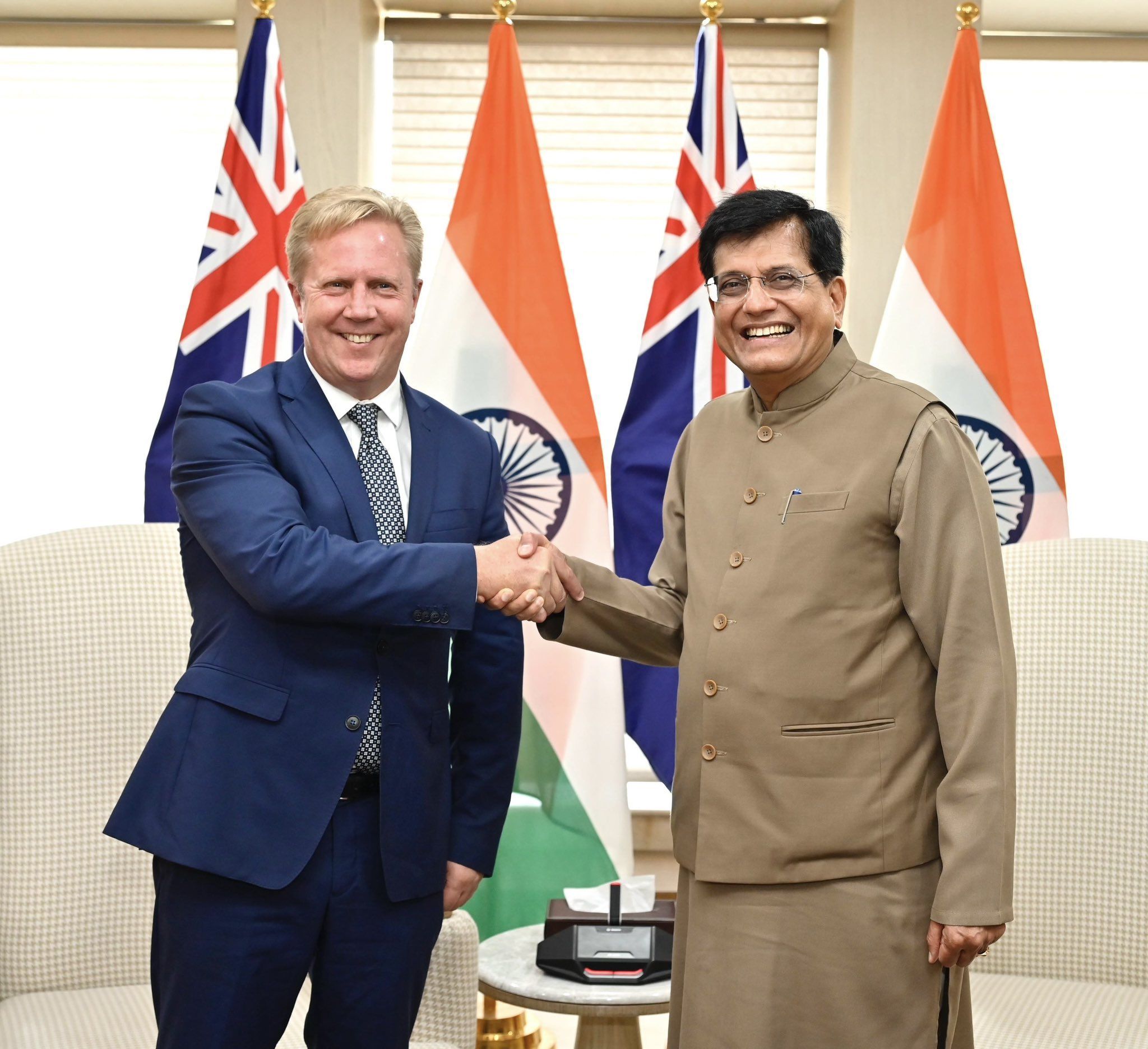
The BGA India team, led by Managing Director Anuj Gupta, wrote an update to clients on the India-New Zealand free trade agreement (FTA).
Context
- India and New Zealand have concluded a next-generation FTA, reinforcing New Delhi’s accelerating push for economic integration with advanced markets. Launched March 16 and concluded after five intensive negotiation rounds, the agreement aligns with India’s long-term economic vision of Viksit Bharat 2047 and its Indo-Pacific strategy.
- Designed as a people-centric trade pact, the FTA goes beyond traditional tariff reduction to focus on four pillars: employment, skills, investment and productivity. It delivers zero-duty market access for 100 percent of Indian exports to New Zealand, while India liberalizes tariffs across 70 percent of tariff lines covering 95 percent of bilateral trade. The deal strengthens competitiveness across labor-intensive manufacturing; agriculture; micro, small and medium-sized enterprises; and high-value services while securing New Zealand’s most ambitious services and mobility commitments to date.
- Strategically, the India-New Zealand FTA follows recent agreements with the United Kingdom and Oman, underscoring a clear sequencing in India’s trade diplomacy toward high-quality FTAs with developed partners. Coming two days after signing the Oman FTA, the India-New Zealand FTA underscores the multi-track approach India has adopted toward trade liberalization. Negotiations with the European Union and Canada are expected to follow. Viewed in this context, the agreement signals a sustained shift toward deeper services integration, investment facilitation and globally competitive trade frameworks.
Significance
- New Zealand will eliminate tariffs on 100 percent of its tariff lines, providing duty-free access for all Indian exports. This materially improves competitiveness for labor-intensive sectors such as textiles, apparel, leather, footwear, marine products, gems and jewelry, handicrafts, engineering goods, automobiles, pharmaceuticals and agricultural products — sectors that are deeply linked to global value chains.
- India is opening its market with calibrated safeguards. The country has committed to tariff liberalization on 70 percent of tariff lines, covering 95 percent of bilateral trade, while maintaining protections for politically and economically sensitive sectors. Market access explicitly excludes dairy, milk and milk products, coffee, sugar, spices, edible oils, onions, rubber and related products, ensuring domestic agricultural and industrial interests remain insulated even as trade expands.
- New Zealand has offered its most ambitious services package in any FTA, covering 118 services sectors with most favored nation commitments across 139 sub-sectors. This includes information technology (IT) and IT-enabled services, professional and business services, education, telecommunications, construction, audio-visual services and tourism, creating meaningful commercial opportunities for Indian firms and global companies operating from India.
- The agreement introduces a liberal and predictable mobility framework, with no numerical caps on post-study work visas. Indian students gain post-study work rights of up to three years for science, technology, engineering and mathematics bachelor’s and master’s graduates and up to four years for doctoral scholars, supporting talent pipelines, global workforce exposure and long-term people-to-people ties.
- A new temporary employment entry visa pathway provides access for 5,000 Indian professionals at any given time,with stays of up to three years, alongside 1,000 work and holiday visas. Eligible professions span IT, engineering, health care, education, construction, traditional medicine practitioners, yoga instructors, chefs and music teachers, strengthening services trade and workforce mobility.
- New Zealand has committed to facilitating US$20 billion in investments into India over the next 15 years, supporting manufacturing, infrastructure, services, innovation and employment under the Make in India framework. This signals a stronger bilateral investment environment and expanded access to Indo-Pacific regional value chains.
Implications
- The FTA facilitates agricultural productivity partnerships with safeguards. It establishes agricultural productivity partnerships through centers of excellence for apples, kiwifruit and honey, focused on technology transfer, research and development, quality enhancement and supply chain efficiency. Productivity cooperation is paired with restricted market access, using quotas and minimum import prices to protect Indian farmers while enabling knowledge transfer.
- The deal will result in lower input costs for the Indian manufacturing sector. India has secured duty-free access to critical industrial inputs such as wooden logs, coking coal and metal waste and scrap. This reduces input costs for downstream manufacturing and supports competitiveness for export-oriented producers.
- The agreement will boost the pharmaceutical and medical devices sector through faster regulatory access. It enables acceptance of good manufacturing practice and good clinical practice inspection reports from trusted regulators, including the U.S. Food and Drug Administration, European Medicines Agency and U.K. Medicines and Healthcare Products Regulatory Agency. This reduces duplicative inspections, lowers compliance costs and accelerates approvals, facilitating growth in India’s pharmaceutical and medical devices exports to New Zealand.
- With exports at a 10-year high increasing national confidence, India is taking very strong steps toward opening up its economy for global trade. A number of other trade agreements — with the European Union, the United States and Canada — are expected to follow shortly.
If you have questions or comments, please contact BGA India Managing Director Anuj Gupta at agupta@bowergroupasia.com.
Best regards,
BGA India Team

×