



















India’s 2025-26 Economic Survey Underscores Macroeconomic Stability and Growth Amid Global Headwinds
The BGA India team, led by Managing Director Anuj Gupta, wrote an update on the Economic Survey 2025-26.
Context
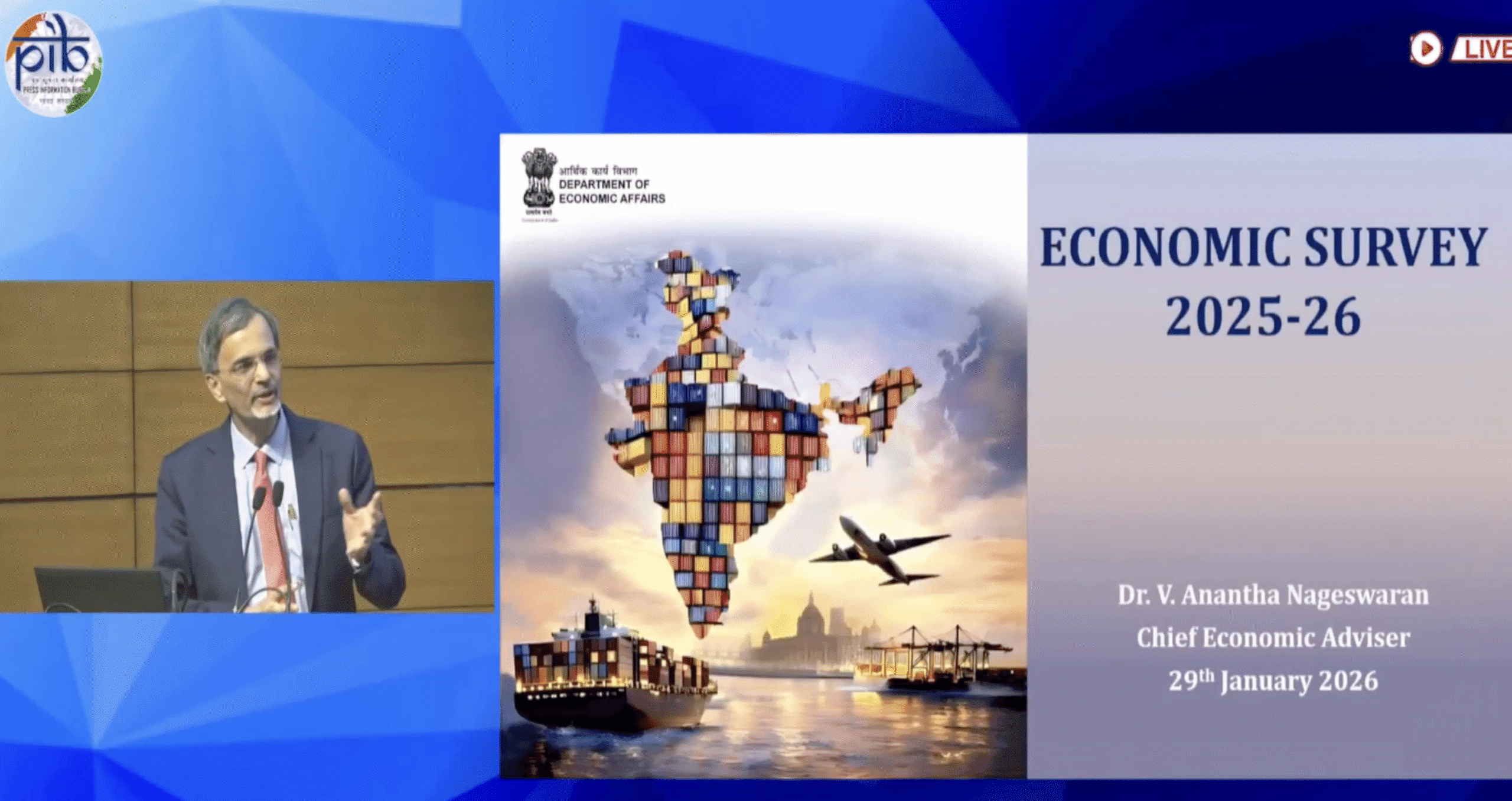
- India’s Union Finance Minister Nirmala Sitharaman tabled the Economic Survey 2025-26 in the Lok Sabha, India’s lower house, on January 29, a day after the budget session of Parliament commenced. Prepared by the Economic Division of the Department of Economic Affairs under the supervision of Chief Economic Adviser V. Anantha Nageswaran, the survey presents the government’s official assessment of the economy’s current state and outlines its outlook for the year ahead.
- A key takeaway is the growth trajectory: India’s real GDP is projected to expand 6.8-7.2 percent in fiscal year (FY) 2027, slightly lower than the estimated 7.4 percent for FY 2026. This performance, driven primarily by domestic demand and capital formation, reaffirms India’s status as the fastest-growing major economy for the fourth consecutive year. The survey also flags that inflation remains anchored, with headline consumer price index inflation averaging 1.7 percent between April-December 2025, while fiscal consolidation and strong domestic demand provided support against global uncertainties.
- The fiscal deficit in FY 2025 was 4.8 percent of GDP, nearly half of what it was during COVID-19 pandemic peak. While revenue receipts improved to 9.1 percent of GDP in FY 2025, driven by buoyant direct tax and GST collection, effective capital expenditure reached 4 percent of GDP, reflecting a decisive shift toward asset creation. India has also reduced its general government debt-to-GDP ratio by 7.1 percent since 2020, and a new fiscal glide path aims to reach a ratio of 50 ± 1 percent by FY 2031.
- Despite strong fundamentals, the document highlights external vulnerabilities such as capital flow volatility and currency pressures, alongside rising state-level fiscal stress and revenue deficits that could influence borrowing costs. These insights set the tone for the Union Budget 2026-27, framing both achievements and risks as policymakers calibrate priorities for sustaining growth and stability.
Significance
- India achieved record total exports of $825.3 billion in FY 2025, supported by strong services growth. The current account deficit narrowed to 0.8 percent of GDP in the first half of FY 2026. While merchandise exports faced global headwinds, including 50 percent tariffs from the United States, non-petroleum exports reached a historic high of $374.3 billion. Foreign exchange reserves reached $701.4 billion in January, providing over 11 months of import cover.
- While the Indian rupee underperformed in 2025, partly due to geopolitical considerations, the survey notes that its recent devaluation does not reflect the underlying macroeconomic fundamentals.
- The manufacturing sector is undergoing a significant structural recovery and shift toward high-technology segments. Manufacturing gross value added accelerated to 9.1 percent in the second quarter of FY 2026, substantially outperforming overall industrial growth. Medium- and high-tech activities now comprise 46.3 percent of total manufacturing value added. The production-linked incentive schemes have mobilized investment of over $24 billion, generating more than 1.2 million jobs, even as the National Manufacturing Mission targets have doubled manufacturing’s GDP share to 25 percent by 2035.
- Services remain the economy’s anchor, with exports growing to $387.5 billion at 13.6 percent in FY2025 and to $199 billion at 9.3 percent in the first half of FY 26. India is a hub for global capability centers, with more than 1,700 centers employing 1.9 million professionals. The “orange economy” (creative industries) and concert economy (which prioritizes experiential spending over goods) are emerging as new levers for urban growth. The space sector is expanding, with NewSpace India Limited revenues projected to be $352.8 million in FY 2025.
- Agriculture recorded growth of 4.5 percent from FY 2016 to FY 2025, the highest in recent decades. While foodgrain production reached 357.7 million metric tons in FY 2024-25, a boost in vegetable and pulse production is leading to a steep correction in food prices. Livestock and fisheries, growing at 7.1 percent and 8.8 percent, respectively, are becoming primary growth engines. The government’s minimum support price, which is 1.5 times the cost of production for 22 mandated crops, and imbalanced fertilizer usage remain as areas of concern.
- India is accelerating its infrastructure push to support growth and connectivity. Between FY 2022 and FY 2026, capital outlay nearly doubled to $121.9 billion. National highways have expanded 60 percent in a decade while 99.1 percent of railways have been electrified, and port capacity reached 2,771 million metric tons, with average container vessel turnaround times falling to 30 hours. Complementing physical infrastructure, digital public infrastructure initiatives such as unit linked insurance plans (a hybrid financial product) are actively reducing logistics costs and improving efficiency across sectors.
- The government is scaling up its energy transition crossing 50 percent non-fossil fuel power targets by reaching 51.9 percent in December, and total renewable energy capacity reached 25 gigawatts. The SHANTI Act 2025 was passed to enable private and state participation in nuclear power, targeting 100 gigawatts by 2047. The National Critical Mineral Mission was launched with a $1.8 billion outlay to secure supply chains for green tech. Domestic adaptation spending rose to 5.6 percent of GDP in FY 2022.
- India is rapidly advancing in artificial intelligence (AI) adoption, with 88 percent surveyed firms using AI in at least one business function, pursuing a bottom-up, application-specific AI strategy rather than chasing energy-intensive frontier models. The IndiaAI Mission focuses on creating open-source, interoperable systems and an “AI-OS” as a public good. GenAI startups tripled to over 890 by mid-2025.
- Age-based limits to accessing social media platforms to counter digital addiction are an emerging priority for states, with Andhra Pradesh and Goa considering a ban for children. These developments will likely have global implications because India is the largest user base for many companies. To balance innovation with social stability, the survey proposes an AI Economic Council to calibrate adoption, safeguard the labor market and address downstream societal impacts of rapid digitalization.
- The survey makes specific focus on fast tracking urban transformation to build more livable and sustainable cities. Key priorities includelast-mile connectivity, citizen-focused planning and circular economy solutions. The $12 billion Urban Challenge Fund is catalyzing bankable urban projects that improve efficiency and sustainability while affordable housing demand, projected at 30 million units by 2030, is another area of opportunity.
- India is deepening its positioning as a critical node in the global supply chain, through trade diversification and deeper integration with major partners, evidenced from its recent free trade agreements including with the European Union. The survey frames this evolution as central to India’s long-term ambition of achieving a “hard currency” status, grounded not in volatile capital inflows but in manufacturing competitiveness, export surpluses, and stable services earnings.
- Human capital indicators show steady gains with focus shifting to better lifestyle and physical health: the education system serves 247 million students with high enrolment levels; health outcomes have improved, with infant mortality down 37 percent over a decade; and the labor force of 562 million is supported by rising female participation and steady job creation. While the rapidly growing gig economy employs 120 million workers, vocational skills penetration have increased sharply, and multidimensional poverty has declined to 11.3 percent, the survey calls for policy attention to emerging risks such as obesity and digital addiction.
If you have questions or comments, please contact BGA India Managing Director Anuj Gupta at agupta@bowergroupasia.com.
Best regards,
BGA India Team

×