















Canadian PM Carney’s Indo-Pacific Trip Seeks To Create ‘Middle Power’ Bonds
Canadian Prime Minister Mark Carney’s February 26 to March 7 trip to India, Australia and Japan marked an effort by Ottawa to develop a deeper Indo-Pacific strategy. He sought to reduce Canada’s overwhelming economic dependence on the U.S. market (almost 80 percent) in response to President Donald Trump’s tariffs. Carney worked to develop deeper ties with “middle powers” in the Indo-Pacific on energy, supply chains and security amid the current less stable global geopolitical atmosphere.
Carney’s goal is to double Canada’s exports to non-U.S. partners, particularly in the Indo-Pacific, within a decade. The prime minister sees the global order fragmenting, prompting him to work to coordinate more closely with countries that could be included in an economic and security framework focused on supply chains, critical mineral and clean energy. The main goal of Carney’s trip was to embed Canada more deeply into Indo-Pacific economic and security frameworks.
Carney earlier visited China in mid-January, the first visit by a Canadian prime minister since 2017 and sought to reset strained bilateral ties and boost trade. The two countries signed an economic cooperation road map, agreeing to focus more closely on trade, energy and agriculture. Canada agreed to lower tariffs on Chinese electric vehicles, and China reduced tariffs on agriculture products, especially canola.
India – Resetting Ties

Managing Director
BGA India
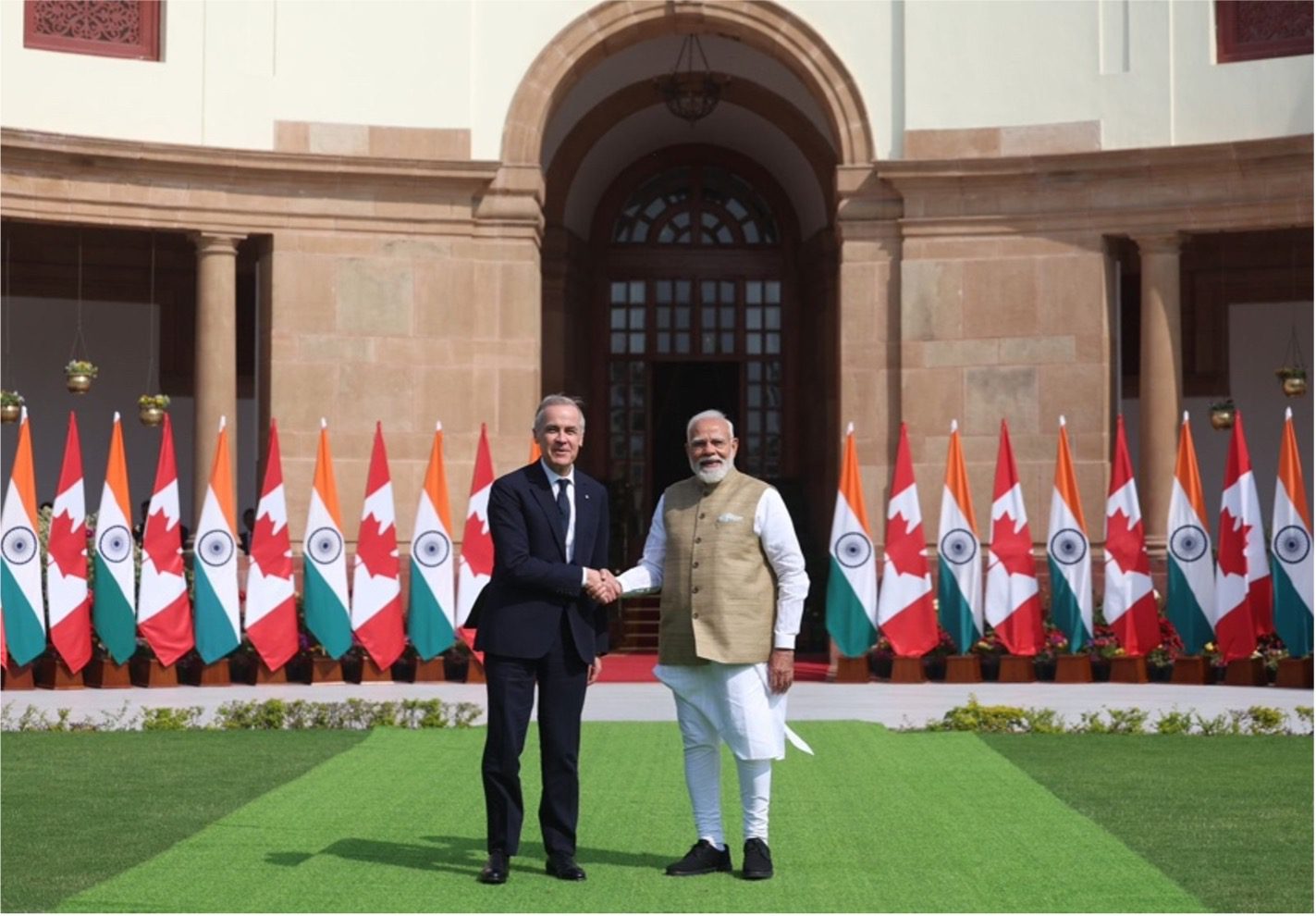
Carney’s visit to New Delhi from February 26 to March 2 was particularly significant because it marked a diplomatic restoration of relations following a damaging bilateral rupture of ties between the two countries. Relations nosedived after former Canadian Prime Minister Justin Trudeau’s 2023 allegations that Indian agents had been involved in the killing of a Sikh activist in Canada. Indian Prime Minister Narendra Modi received Carney at Hyderabad House with the full weight of a state visit, sending a signal that the rupture was over and both sides were ready to move.
The deliverables of Carney’s visit were substantive: eight agreements were signed spanning critical minerals, a $2.6 billion uranium supply deal, liquid natural gas (LNG), defense cooperation, artificial intelligence (AI) and education. The two countries signed commercial agreements worth $5 billion, including on energy, minerals and pharmaceuticals. The terms of reference for a Comprehensive Economic Partnership Agreement were finalized, with a deal targeted by end of 2026, a concrete timeline that moves the relationship into structured expansion. The two-way trade target of $50 billion by 2030, up from approximately $13 billion today, signals genuine ambition rather than diplomatic optics.
For India, the visit aligns with its wider strategic doctrine of diversifying and deepening relationships with complementary middle powers, a pattern visible in the European Union free trade agreement concluded weeks earlier and the Australia-Canada-India Technology and Innovation Partnership (ACITI), launched at the Group of 20 in South Africa in November. Canada can contribute toward India’s multiple structural needs: uranium for its civil nuclear program, LNG and critical minerals for its energy transition, pension fund capital for infrastructure and AI expertise. India brings what Canada needs as it pivots away from U.S. market dependence: scale, a fast-growing consumer market and Indo-Pacific positioning.
Carney’s New Delhi visit and the distance traveled, politically and diplomatically, makes the development more significant than the sum of its deliverables.
Australia – Boosting Critical Mineral Cooperation

Managing Director
BGA Australia
Carney’s March 3-5 visit to Australia was largely viewed through the prism of middle-power diplomacy, supply chains and the deteriorating strategic environment, especially in the context of the Trump administration’s disdain for the rules-based order. Prime Minister Anthony Albanese, like Carney, is a center-left leader who won strong election victories in 2025, partly due to backlash against Trump. Australia and Canada, both members of the “Five Eyes” intelligence network, have long had warm ties at government and people-to-people levels.
The leaders’ joint statement committed to modernizing the Australia-Canada Tax Treaty to facilitate greater investment (Australia and Canada have two of the largest pools of pension funds) and mentioned the signing of the new Australia-Canada Clean Energy Partnership. They also welcomed enhanced collaboration between their AI safety institutes and noted discussions on establishing a Status of Forces Agreement and a biennial defense ministers’ meeting. The two leaders discussed their ACITI partnership with India, which seeks to boost cooperation in emerging technologies, supply chains, clean energy development and AI.
In his address to the Australian Parliament, Carney declared Australia and Canada “the world’s critical mineral superpowers,” which should be “strategic collaborators.” The two leaders, whose countries signed a Joint Declaration of Intent on Critical Minerals Cooperation at the Group of Seven summit in November, aimed to reduce their dependence on China and committed to deepening collaboration between Australia’s Critical Minerals Strategic Reserve and Canada’s Critical Minerals Sovereign Fund.
Japan – Pursuing More Economic Cooperation

Managing Director
BGA Japan
Carney met Japanese Prime Minister Sanae Takaichi in Tokyo March 6. The two leaders agreed to establish a new policy dialogue on cybersecurity and economic security and reaffirmed their commitment to strengthening cooperation toward realizing a “free and open Indo-Pacific.” They also agreed to elevate Japan-Canada relations to a Comprehensive Strategic Partnership and to develop a road map outlining cooperation in the areas of security, energy and LNG supply and economic security.
Prior to the summit, some observers had focused on how Takaichi would respond to Carney’s call for greater coordination among middle powers. In the end, while the issuance of a joint leaders’ statement for the first time in more than two decades was symbolically important, the substance of the announcement was largely conventional, emphasizing strengthened bilateral cooperation.
During their joint press appearance, Carney noted that roughly three-quarters of automobiles produced in Canada are manufactured by Japanese automakers. The remark could be interpreted as highlighting the potential implications of the upcoming review of the United States-Mexico-Canada Agreement for Japan. Ultimately, the key question will be how Canada concludes its trade negotiations with the United States and whether in the end Ottawa continues to support investment by Japanese companies in Canada.
If you have questions or comments, please contact BGA Head of Research Murray Hiebert at mhiebert@bowergroupasia.com.
Best regards,
BowerGroupAsia