















Korea Forecast: AI-Led Growth Meets Political Rebalancing

WHAT YOU NEED TO KNOW
- Korea marked the highest growth among the world’s major economies during the first half this year, driven by the semiconductor boom. The main stock index continues to break all-time records, despite sustained currency weakness.
- The economy is expected to remain on the upswing in the foreseeable future following the artificial intelligence (AI)-led semiconductor boom and efforts to end the Iran war.
- President Lee Jae Myung had sustained approval ratings near 60 percent during the first five months of 2026 due in large part to Korea’s economic windfall. He has strong support for his foreign policy, economic and livelihood management and administrative competence.
- The ruling Democratic Party (DP) maintains its legislative dominance amid a fragmented conservative opposition following the 2024-2025 martial law-related turmoil.
- The June 3 local elections, the first nationwide vote since Lee took office last year, placed DP-supported mayors and governors in many local governments. However, the DP did not win key races such as the Seoul mayoral election. This highlights internal divisions within the ruling party, together with declining support for the president in the polls.
ON THE HORIZON
- The strong dollar, high oil prices and prospects for higher interest rates remain key economic challenges. The government will continue to prioritize energy security by strengthening crude oil and naphtha supply stability, emphasizing strategic stockpiling and diversified import routes to manage impacts on the trade balance and industrial output.
- The new Bank of Korea governor, Shin Hyun-song, is viewed as a pragmatic hawk likely to support preemptive rate action if signs of inflation materialize.
- On the policy front, following the June local elections, political focus will shift to the September 2026 National Assembly audit, highlighting consumer protection, data privacy and unfair corporate practices as oversight shifts toward livelihood issues.
Korea Market Overview and Forecast
Political Climate
Voters Want Balance
President Lee went into the June 2026 local elections with strong public support. With approval ratings over 60 percent and the ruling DP maintaining a wide lead over the opposition, the administration was expected to begin the second half of the year with strong political momentum.
In the June 3 elections, Lee’s progressive DP won 12 of 16 metropolitan mayoral and provincial gubernatorial seats, marking a significant victory. However, the conservative opposition People Power Party (PPP) saw its future presidential hopefuls — mostly political moderates — score dramatic political comebacks in Seoul’s mayoral race and elsewhere. This suggests that Korean voters are not in favor of the DP’s absolute political dominance over the PPP.
The electoral results have produced an unexpected new political landscape. Lee’s approval rating began falling below 50 percent, with disapproval exceeding approval for the first time in the fourth week of June. The incumbent leaders of both parties now face pressure to resign and have been accused of marginalizing centrists and becoming increasingly extremist.
Nevertheless, Lee continues to be viewed as a competent leader. With the local elections behind him and most of the local governments under the control of his party, his government is expected to enjoy an extended period of relative political stability. However, the surge of opposition moderates and the fall in presidential approval ratings will force him to balance carefully. If the moderates eventually take control of the opposition PPP, they are expected to launch formidable political challenges against the Lee government.
Macroeconomic Climate
Semiconductors Drive the Economy, Inflation and Currency Concerns Linger
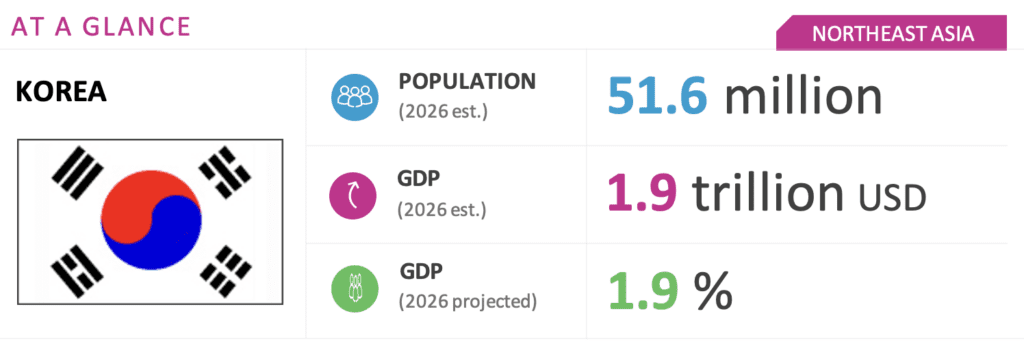
Korea recorded the highest nominal GDP growth (10.5 percent from the previous period) in 50 years in the first half of this year — the fastest among the world’s major economies. During the same period, Korea’s current account surplus ($74.4 billion) was the second largest globally after China, overtaking Germany and Japan. While the International Monetary Fund forecasts GDP growth of 1.9 percent in 2026, the Organization for Economic Cooperation and Development’s growth projection is significantly higher at 2.6 percent.
This performance was made possible by semiconductor exports that grew by nearly 150 percent in the last year. Other exports, particularly in heavy manufacturing industries such as defense, shipbuilding and petrochemicals, also contributed significantly. The economic boom drove Korea’s main stock index from the 3,000 level just one year ago to the 9,000 range in June, making it the world’s sixth-largest stock market by market capitalization.
Despite the fast-rising stock prices, the Korean won has been losing its value, dropping from the 1,400 won to the U.S. dollar range at the beginning of the year to the 1,540 range by late June. Foreign exchange reserves remained largely unchanged during the same period, marking close to $430 billion, the world’s seventh to eighth largest — bigger than that of Germany. China and Japan also experienced weakening currencies in the same period, but Korea’s case appears to have been worse.
In response, the Bank of Korea (BOK) in early June committed to raising the key interest rate in the coming months. The semiconductor boom could make a rate increase less painful than usual. After holding the benchmark base rate steady at 2.5 percent for eight consecutive meetings through May 2026, the BOK will likely pivot to a tightening cycle.
A weak won directly translates to higher costs for imported energy, which has already forced the BOK to raise its 2026 inflation forecast to 2.7 percent. With growth concerns alleviated by semiconductor performance, BOK Governor Shin has signaled that conditions have fully matured for a base rate hike.
Investment Environment
Rerating Window Opens as Index Flows and Reform Align
Korea was the second most competitive economy, behind the United States, in the IMD 2026 World Competitiveness Ranking’s 30-50 Club — the world’s largest economies with over $30,000 in per capita GDP and populations exceeding 50 million. Korea’s advanced technology and heavy manufacturing businesses performed well despite the ongoing Russia-Ukraine war, the sudden outbreak of the Iran war and global supply chain turmoil, producing large current account surpluses and high GDP growth numbers in the first half the year. This trend is expected to continue in the second half of the year.
The conditions of Korea’s financial market for international investors during the remainder of the year will be shaped by three forces: steady capital inflows resulting from inclusions into the world’s leading investment indexes, upgrades in market ratings driven by capital-market-friendly government policies and the continuing booms of leading industrial sectors such as semiconductors, shipbuilding and defense.
Korea’s phased FTSE World Government Bond Index inclusion, which began in April and will be completed in November, is set to anchor rates and foreign exchange as sizeable passive flows arrive through the second half. At the same time, the National Growth Fund (Mega-Project) is moving into execution with a clear goal of narrowing the Korea discount, backed by corporate-governance reform and stronger requirements for shareholder returns.
MSCI Developed-Market reclassification remains a longer-term potential catalyst. Korea was not added to MSCI’s watchlist in the June 2026 review, which could have made formal reclassification possible from 2028 at the earliest. The launch of round-the-clock foreign exchange trading in July 2026 is the most concrete reform deliverable; remaining concerns flagged by MSCI include the foreign investor registration process, omnibus account and over-the-counter trading restrictions, English-language disclosure and dividend record-date timing. The government is expected to announce additional reform measures in July’s second half-yearly economic growth strategy.
Against this backdrop, Korea’s semiconductor cycle remains the biggest driver of its export and earnings story, as the industry shifts from AI model training to inference. This is accelerating AI infrastructure spending and raising the amount of memory built into each server. As a result, high-bandwidth memory and dynamic random-access memory demand is set to stay strong through year-end, supported by global AI infrastructure spending that is now tracking above KRW 1 quadrillion ($677.4 billion) a year.
AI data center and energy infrastructure build-out is being structurally accelerated by the West Coast Energy Highway project and passage of the AI Data Center Special Act, which together remove power-, siting- and permitting-related bottlenecks. The result is a multi-year capex tailwind for utilities, transmission and distribution and construction names as the domestic AI infrastructure cycle is pulled forward.
We will continue to keep you updated on developments in Korea as they occur. If you have questions or comments, please contact BGA Korea Managing Director B.J. Kim at bjkim@bowergroupasia.com.
Best regards,
BGA Korea Team