
















Thailand Secures US Trade Framework and Rare Earths Agreement
BGA Senior Adviser Thitinan Pongsudhirak wrote an update to clients on the new Thailand-U.S. trade framework.
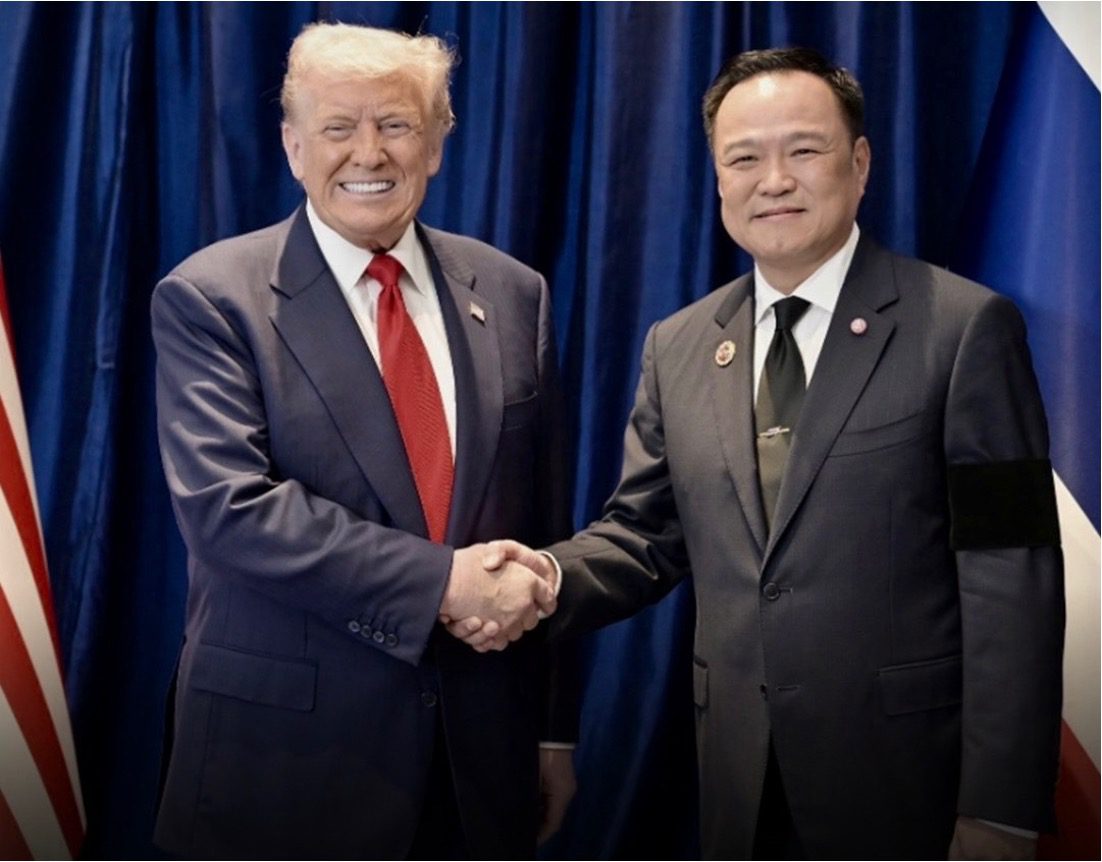
U.S. President Donald Trump has taken Asia by storm this past week, stopping first in Kuala Lumpur October 26 before moving on to Japan and Korea for the next four days. Trump capped his trip by meeting with Chinese President Xi Jinping before returning to Washington, but his appearance at the Association of Southeast Asian Nations (ASEAN) Summit was the most consequential for Southeast Asian economies. Brandishing unilateral tariffs set last April as leverage, Trump weaponized the United States as the world’s largest export market. He succeeded in exerting pressure to follow through with his “Make America Great Again” pledge, finalizing trade concessions and inducing inbound investments. For Thailand, Trump left behind a Framework Agreement on Reciprocal Trade and a Memorandum of Understanding to Diversify Global Critical Minerals Supply Chains and Promote Investments.
Trump evidently learned from his last foray in Asia in 2017 during his first term when he visited Vietnam and the Philippines. His deliverables at that time were limited and less concrete. They culminated in a broad geostrategic posture known as the “Free and Open Indo-Pacific,” which was codified in the National Security Strategy and National Defense Strategy by early 2018. After that, he did not visit Southeast Asia again for the ASEAN-related summit meetings. This time, he helped steer the summit by presiding over the signing of a peace accord between Cambodia and Thailand, whose militaries clashed for five days in July over a border dispute. In the Malaysian capital, the signing burnished Trump’s peacemaking credentials, while Cambodia and Thailand were incentivized to finalize trade deals with the Trump team during his visit. Trump used tariff threats and trade demands to secure a peace deal aligned with his preferences — trade for peace. Cambodia and Thailand, in turn, capitalized on the opportunity to finalize agreements.
For Thailand, both the framework and memorandums have attracted scrutiny and raised eyebrows in Bangkok. Even the staunchly pro-establishment minority government of Prime Minister Anutin Charnvirakul of Bhumjaithai Party has not been spared criticism about having given in a lot and getting little in return. Had these agreements been made under a government headed by the Shinawatra family and Pheu Thai Party, or the progressive People’s Party that won the last election, it would have likely led to accusations of selling out the country and even treason. This means that the Anutin government has the best chance to ink these deals in the coming weeks. The U.S. side has indicated November 27 as a preferred deadline.
While the White House website provides the full text of both agreements, the reciprocal trade provisions feature Thailand’s elimination of tariffs on roughly 99 percent of goods, including U.S. industrial and food and agricultural products. Nontariff barriers, such as acceptance of U.S.-manufactured vehicles approved by U.S. safety and emissions standards and medical devices and pharmaceuticals certified by the U.S. Food and Drug Administration, are also included. The framework additionally stipulates purchases of ethanol from the United States and U.S. Food and Safety and Inspection Service-certified meat and poultry products while freeing up digital trade, allowing unionization and promoting labor and workers’ rights. Thailand also agreed to buy 80 U.S. aircraft worth $18.8 billion and energy products, such as liquefied natural gas, crude oil and ethane for another $5.4 billion per year.
While the Thai side was keen to lower the 19 percent reciprocal tariff, the framework agreement required that any reduction to zero percent be conditional on additional executive order provisions. In other words, Thailand’s compliance in good faith and wide-ranging concessions were designed to slash the set tariff rate to gain price competitiveness but this objective will be determined by Washington at a later stage.
Thailand is not alone in making these concessions. Cambodia, Malaysia and Vietnam are in the same boat. The Malaysian-U.S. trade agreement, in fact, may serve as a benchmark for Southeast Asia’s final trade deals with the United States, including Indonesia and the Philippines down the road. Similar to Malaysia, Cambodia finalized a deal with the Trump team that eliminated 100 percent tariffs on U.S. goods.
For Thailand, the trade framework has become less controversial than the memorandum of understanding on critical minerals and rare earths. Thailand is not a major producer and player in the rare earths mix. Its deposits are estimated to be about 4,500 tons, a fraction of Vietnam’s 3.5 million tons, Australia’s 5.7 million, Brazil’s 21 million and China’s 44 million tons. Granted, Thailand is a significant processor of rare earths, particularly those imported from Australia. While the U.S. negotiating team included the same rare earths provisions with other Southeast Asian economies in a strategy to reconfigure supply chains of critical minerals toward the United States and away from China, the memorandum with Thailand has had adverse repercussions.
The Anutin government, particularly Foreign Minister Sihasak Phuangketkeow, wants Thailand to reappear in the international affairs spotlight — to be a regional player with a role on the global stage again. The memorandum on critical minerals was intended to plug Thailand on crucial supply chains, with positive spillovers for innovation and economic upgrading toward electric vehicles, batteries, data centers, the green transition, artificial intelligence and overall climb up global value chains. For the United States, enlisting Thailand and its peer group on critical minerals and rare earths comes with a low cost and potentially high yield if supply chains of this key high-tech geoeconomic battleground can become more accessible and secured.
As the dust settles after Trump’s thumping Asia tour, it will not be surprising if partner countries feel a sense of remorse — that they may have gone too far in appeasing and accommodating the U.S. president’s tariff threats and trade demands. None of these countries like to be pushed around unilaterally, but they need to go along for the time being owing to their reliance on the U.S. market.
It is likely that for the rest of Trump’s second term, Southeast Asian countries will aim to diversify and scale back their export exposure in the U.S. market as much as possible. If so, this effort could boost and become a boon for other trade policy platforms that exclude the United States, such as the Regional Comprehensive Economic Partnership and the Comprehensive and Progressive Agreement for Trans-Pacific Partnership. Even though they are not directly focused on trade liberalization, other plurilateral and multilateral forums, such as the BRICS+ and Global South, may gain more traction as a “world minus one” alternative in the medium term, as the United States under Trump alienates itself from partners and allies.
We will continue to keep you updated on developments in Thailand as they occur. If you have comments or questions, please contact BGA Senior Adviser Thitinan Pongsudhirak at thitinan@bowergroupasia.com or BGA Thailand Managing Director Teerasak “Art” Siripant at tsiripant@bowergroupasia.com.
Best regards,
BGA Thailand Team