















US Inaugurates Pax Silica With Seven Allies
BGA Technology Senior Director William Heidlage and Director Apoorva Kolluru wrote an update to clients on the launch of Pax Silica.
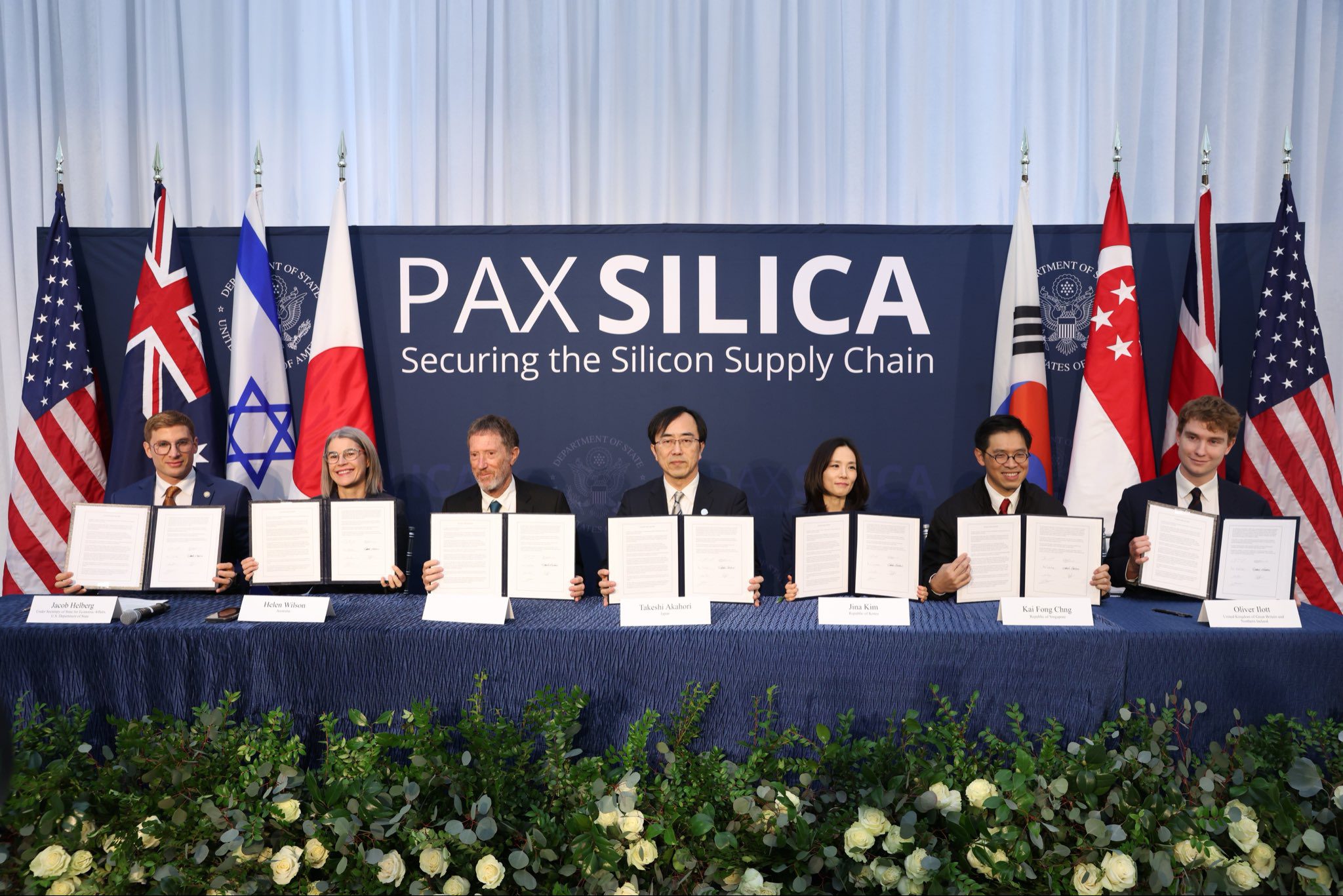
The U.S. inaugurated the Pax Silica initiative with seven allied nations December 12. Five countries — Japan, Korea, Singapore, the United Kingdom and Australia — signed the founding declaration alongside the United States. The Netherlands, Israel and the United Arab Emirates (UAE) participated in the inaugural event but did not sign. Taiwan, the European Union, Canada and the Organization for Economic Cooperation and Development attended as observers. In the coming months, Pax Silica is expected to expand to include more allies and partners with mineral, technological and manufacturing processes. U.S. Undersecretary of State for Economic Affairs Jacob Helberg said Pax Silica would become indispensable to the artificial intelligence (AI) age, comparing it to the Group of Seven.
The administration of U.S. President Donald Trump hopes to cement a coalition that better competes with China in areas such as critical minerals, semiconductors and digital infrastructure. The initiative seeks to build on and drive much of what the Trump administration has previously sought in bilateral and trilateral formats in the AI space. BGA expects that the initiative will accelerate the rerouting of supply chains. This will increase both costs and opportunities, particularly through project development in critical minerals, semiconductor manufacturing, data centers and sub-sea cable projects.
The grouping encourages cooperation and will invite collaboration between members that have not traditionally worked closely together in the AI space. It also builds short-to-medium-term dependencies on those within the grouping, isolating others. The underlying logic is to reduce coercive risks from strategic dependence on China by coordinating industrial policy to protect sensitive technologies and critical infrastructure. The group seeks to strengthen trusted technology ecosystems, support long-term offtake arrangements and coordinate responses to overcapacity and dumping so supply chains remain secure and resilient.
BGA expects two likely impacts as the initiative’s implementation strategies evolve. First, technology supply chains will accelerate rerouting and diversification in the short term, prioritizing locations in allied jurisdictions and potentially raising costs for critical mineral imports, semiconductor manufacturing, data centers and sub-sea cable landing site projects. The grouping will likely implement this rerouting through a mix of project financing subsidies, export controls and regulations. Members are also expected to benefit from advanced chips, the U.S. AI stack and respite from various export controls. Second, the widening technology divide between China and the Pax Silica members will increase regulatory fragmentation, adding complexity to the regulatory landscape and supply chains for companies in this domain.
The coalition marks a strategic shift in the administration’s embrace of multilateralism. During Trump’s second term, the United States and its allies have complemented each other’s AI strategies, primarily in various bilateral and minilateral formats. The recent U.S.-UAE-Japan cooperation on data centers is one such example, with the UAE pledging to align its national security regulations with Washington’s standards.
With this in mind, it is important to note key omissions from the initial coalition. India, which has seen major investment in digital infrastructure from U.S. firms, did not participate. It is also unclear why the UAE and Netherlands did not sign the declaration despite participating or why Canada only participated as an observer. Taiwan’s absence is also notable because it would play a critical role in the initiative given its centrality to semiconductor supply chains. BGA sources indicate that Taiwan’s participation was limited at the request of two of the initiative’s founding members.
It remains to be seen how exclusive the grouping becomes, partly as a measure of how AI diffusion policies are developed and applied to those outside the bloc. The timing of the inaugural event, the same week Trump announced the United States would not block sales of Nvidia’s H200 processors to China, is also notable in terms of understanding the administration’s evolving diffusion policy. U.S. AI diffusion policies increasingly appear to support business investment by shedding technical design-focused export controls and instead emphasizing uptake of the U.S. AI stack over the Chinese stack.
We will continue to keep you updated on technology developments as they occur. If you have comments or questions, please contact BGA Technology Senior Director William Heidlage or Director Apoorva Kolluru.
Best regards,
BGA Technology Team