
















Singapore’s New Research and Innovation Push: From Lab to Market
The BGA Singapore team, led by Managing Director Nydia Ngiow, wrote an update to clients on Singapore’s Research, Innovation and Enterprise (RIE) 2030 plan.
Context
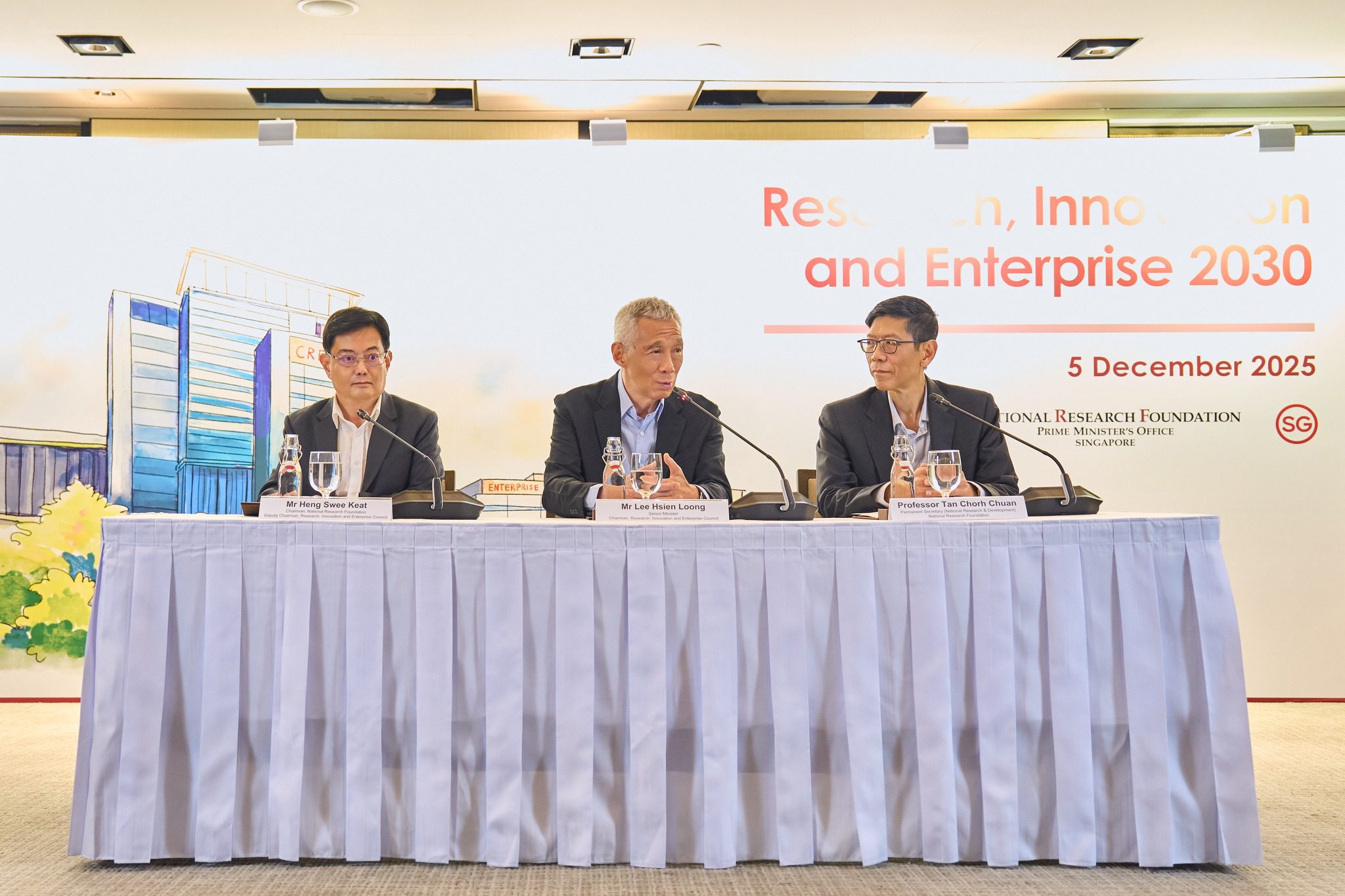
- Singapore’s National Research Foundation released its RIE 2030 plan December 5, setting aside SGD 37 billion (US$28.6 billion) over the next five years for research and innovation in key economic sectors and national priorities, including semiconductors and aging. The plan aims to translate discoveries into commercial value and solutions to national problems. Senior Minister Lee Hsien Loong, in his role as chair of the RIE Council, underscored that research and innovation will become even more critical as Singapore’s economy matures, serving as engines for economic growth and tools to address national strategic priorities and challenges.
- Now in its eighth iteration, the RIE2030 maps out Singapore’s key directions, priority areas and programs to deepen research capabilities, accelerate innovation and strengthen the country’s talent ecosystem. Companies should note that new plan places greater emphasis on industry co-development, public-private partnerships and faster pathways from research to commercialization. While the four core domain areas remain unchanged from RIE2025, the targeted focus on semiconductors and Singapore’s aging society signals the government’s immediate priorities. Details of the next flagship and grand challenge will provide further insight into other emerging areas of national importance.
- The National Research Foundation noted that multinational companies have not scaled back research activities despite global trade tensions, indicating expectations that multinationals will continue to shoulder a substantial share of Singapore’s innovation efforts. Nevertheless, latest plan introduces stronger incentives and larger funding pools for industry collaboration, including expanded grants, domain-level innovation programs and new test beds for deployment. The new RIE Flagship and RIE Grand Challenge create clear opportunities for co-research, data partnerships and commercial deployment. At the same time, new cross-border collaboration, starting in Europe under the Horizon Europe complementary fund and likely expanding further, open another channel for partnership. Importantly, Singapore’s stable and consistent RIE investment strategy provides companies with policy continuity to enable multi-year planning and long-term innovation commitments.
Significance
- RIE2030’s SGD 37 billion ($28.6 billion) budget marks a 32 percent increase from RIE2025’s SGD 28 billion ($21.6 billion) budget. It will start from April 2026 and, like in previous iterations, amounts to around 1 percent of Singapore’s gross domestic product. This puts Singapore on par with other small, advanced economies, such as Sweden and Denmark.
- SGD 10.8 billion ($8.3 billion), or 29 percent of RIE2030, will go to four existing areas (unchanged from five years earlier):
- Manufacturing, trade and connectivity: This looks to strengthen Singapore’s position as an advanced manufacturing and logistics hub, focusing on areas such as semiconductors (see below point on RIE Flagships), supply chain technologies, robotics and artificial intelligence (AI). It will also support emerging sectors such as the space economy and bioeconomy. This involves partnerships with multinational companies, which have not scaled back their research activities despite trade tensions, likely because Singapore’s research strengths are aligned with their interests.
- Human health and potential: Funding will continue to go toward building Singapore as a biomedtech and biomanufacturing hub and supporting precision health and translational research for disease prevention and treatment for cancer, cardiovascular and metabolic diseases. Research will also go into cognitive development and skills acquisition at different ages (see below on RIE Grand Challenge).
- Urban solutions and sustainability: This will focus on climate resilience and the low-carbon transition to strengthen capabilities in climate science and adaptation and to set up Centers of Excellence. There will also be a stronger focus on real-world deployment of technologies to ensure low-carbon technologies are feasible across various sectors.
- Smart nation and digital economy: This aims to deepen capabilities in AI, quantum technologies and digital trust as well as support the deployment of these technologies. Funding will also go toward building a talent pipeline and partnerships.
Implications
- Business expenditure on research and development increased from more than SGD 4 billion ($3.1 billion) in 2013 to over SGD 8.1 billion ($6.3 billion) in 2023, with multinational companies continuing to be the largest contributor. The number of industry researchers also increased 25 percent in the same period. Lee emphasized how the Singapore government believes in sustaining stable and consistent investments in RIE over the long term. This will allow companies that intend to launch projects or programs to do so with the confidence of continuity, which is why Singapore continued to keep the investment proportion stable and focus on programs that deliver significant contributions and are scientifically valuable.
- Lee highlighted the momentum in Singapore’s tech startup ecosystem, noting that in the past five years, deep tech startups have attracted SGD 1 billion ($772 million) or more in venture capital funding annually, a reflection of their quality and growing commercial potential.
- Heng emphasized the “symbiotic” relationship between researchers and companies, commenting on how the government has had many discussions with companies about what they need to do to better understand the industries’ needs. He added that Singapore continues to invite more private sector investments in the RIE space, as this further strengthens Singapore’s RIE ecosystem.
RIE2030’s website can be found here. Please reach out to Managing Director Nydia Ngiow if you have any questions or comments.
Best regards,
BGA Singapore Team

×