
















Taiwan and US Announce Moves To Boost Supply Chain Security and Digital Infrastructure Cooperation
The BGA Taiwan team, led by Senior Adviser Rupert Hammond-Chambers, wrote an update on the U.S.-Taiwan Economic Prosperity Partnership Dialogue (EPPD).
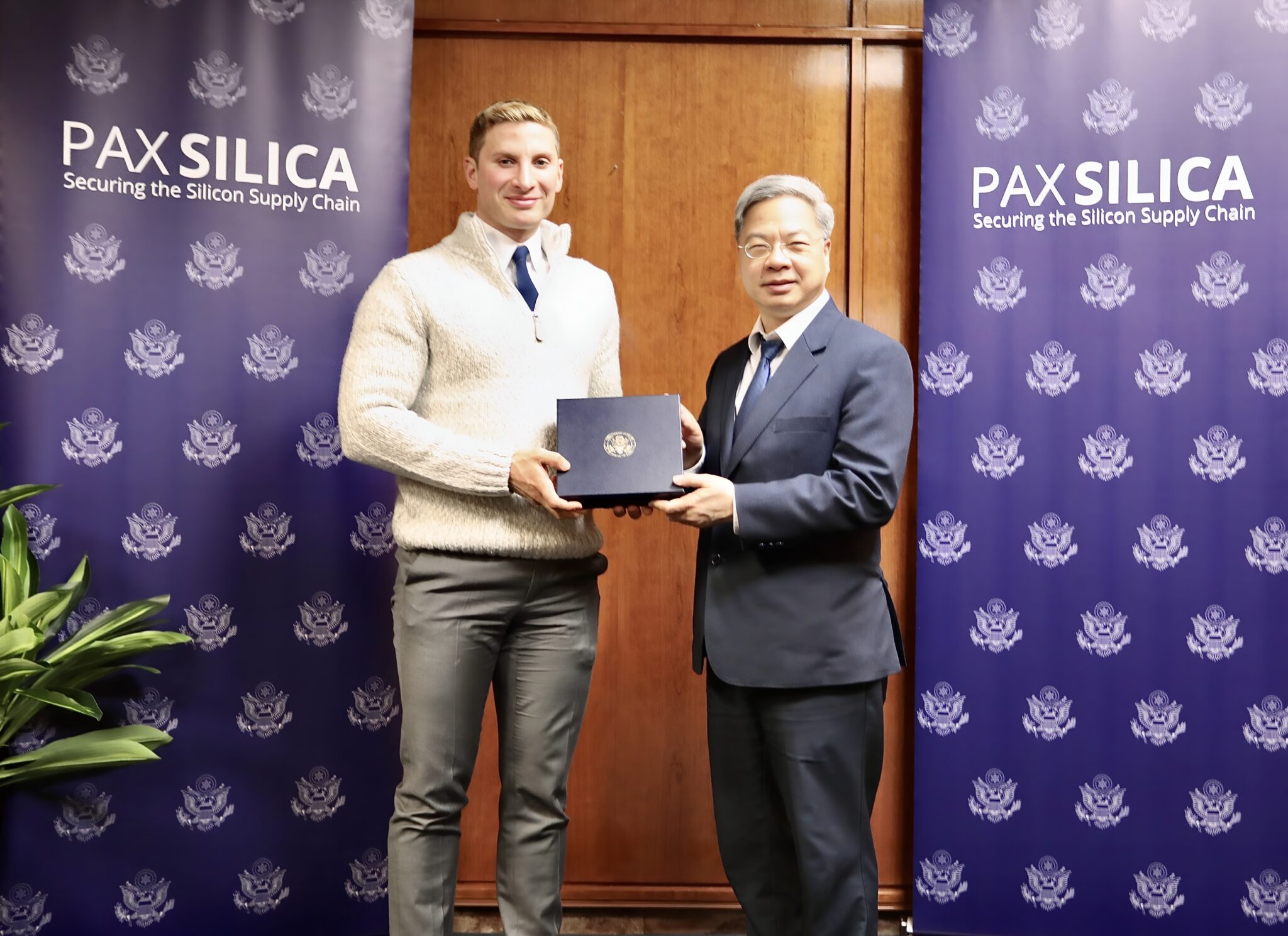
The sixth EPPD concluded in Washington January 27. Undersecretary Jacob Helberg and Economy Minister Kung Ming-hsin witnessed AIT and TECRO sign a joint statement endorsing the Pax Silica Declaration and broader U.S.-Taiwan economic security cooperation. The joint statement is framed around artificial intelligence (AI) and semiconductor supply chain security, drone component certification, countering economic coercion, third-country cooperation and tax-related barriers to investment.
The Ministry of Economic Affairs’ official readout framed the EPPD outcomes — together with the joint statement — around seven areas of consensus, as follows:
- AI supply chain security: strengthen U.S.-Taiwan partnerships in AI technology and advanced robotics, continue work on trusted traditional Chinese corpora for large language model applications and explore trusted AI systems cooperation in third countries. (Trusted traditional Chinese corpora includes high-quality and annotated datasets that can be used for AI training and linguistic research).
- Digital infrastructure: explore LEO (low Earth orbit) satellite cooperation and undersea cable security, strengthen digital infrastructure and cooperate on supply chains for open networking and next-generation communications (for example, 6G).
- Critical minerals: deepen cooperation on mining, refining and new sources and expand technical exchanges, including e-waste recycling.
- Unmanned aerial systems (drones): develop certification pathways to enable market access and commercialization; build a U.S.-Taiwan “non-red” supply chain involving primarily democratic countries and reference Industrial Technology Research Institute’s Green UAS assessor/service arrangement with the Association for Unmanned Vehicle Systems International.
- High-tech talent: advance AI talent development and training and exchange views on an “AI academy” cooperation framework.
- Third-country cooperation: explore projects in shared priority regions, explicitly including the Philippines and Latin America.
- Bilateral economic cooperation: strengthen coordination on investment screening and accelerate work on double-taxation issues.
At first glance, the dialogue fits the classic EPPD mold: an agenda-heavy but deliverable-light outcome, anchored in alignment language and follow-on working groups rather than immediate, measurable policy shifts. The joint statement changes, however, if the EPPD placed next to the Donald Trump administration’s 2025 National Security Strategy (NSS), released in December. The NSS explicitly prioritizes deterring conflict over Taiwan, links that priority to Taiwan’s semiconductor dominance and regional sea-lane dynamics and notes that the United States will field forces capable of denying aggression along the “first island chain” (a string of islands from the Kamchatka Peninsula to Borneo) while pressing first island chain allies and partners to do more to prevent any attempt to seize Taiwan.
Under the NSS framework, this round of EPPD looks less like a trade dialogue and more like an economic-security channel aimed at strengthening Taiwan’s ability to withstand disruption and coercion. Pax Silica best captures that shift by treating semiconductors and AI as strategic assets inside a trusted technology group, where aligned standards and tighter supply chain controls support a denial strategy.
Taiwan’s status is part of the design. Taiwan is not a Pax Silica signatory, but the State Department lists it as a non-signatory participant. This puts Taiwan inside the trusted group while avoiding the political and legal steps of formal accession. In practice, EPPD is a key bilateral channel for operationalizing this arrangement over time.
The second shift moves the agenda from prosperity toward survivability, most clearly in the drone and infrastructure tracks. Drone certification and the push for a non-red supply chain, together with undersea cable security and low-Earth-orbit satellite cooperation, align with contingency needs such as communications redundancy, trusted suppliers and the ability to keep critical systems running under disruption or coercion.
The third shift is about linking the wider operating area through economics rather than relying only on bilateral coordination. By naming the Philippines as a priority for third-country cooperation, the readout suggests an effort to extend resilience and supply-chain footprints beyond Taiwan and tighten the first island chain through projects and shared economic stakes, instead of formal security commitments.
The more useful takeaway is structural rather than transactional. In Taiwan’s post-tariff messaging, the government has pointed to EPPD and other mechanisms as the way to keep U.S.-Taiwan coordination moving on supply chains, digital trade and technology cooperation.
In that context, Pax Silica provides a political frame, while drones, trusted infrastructure and third-country cooperation are the most likely areas to generate early implementation work.
We will continue to keep you updated on developments in Taiwan. If you have any comments or questions, please contact BGA Taiwan Senior Adviser Rupert Hammond-Chambers at rupertjhc@bowergroupasia.com .
Best regards,
BGA Taiwan Team