


















China Charts New Path of Innovation-Led Growth as 15th Five-Year Plan Takes Effect
BGA China Adviser Eric Wang and Account Manager Sam Overholt wrote an update to clients on China’s National People’s Congress and the 15th Five-Year Plan.
Context
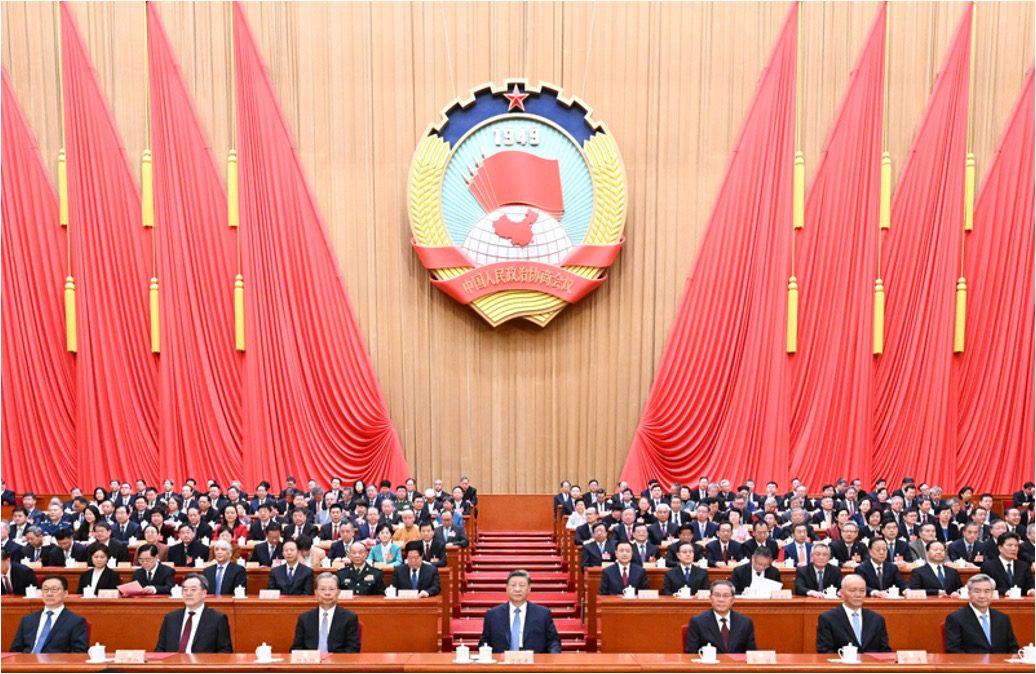
- China’s National People’s Congress concluded March 12, officially approving the 15th Five-Year Plan and enacting the National Development Planning Law, which embeds the five-year plan into statute for the first time in the country’s history. The newly set GDP target of 4.5-5 percent, the lowest range since 1991, reflects a broader strategic intent, which is further evidenced by the new legal framework for planning.
- Historically, the 14th Five-Year Plan delivered robust results, achieving 5.4 percent average annual GDP growth and maintaining research and development investment at 2.8 percent of GDP, in turn establishing a solid foundation. The 15th Five-Year Plan builds on these achievements, offering a new direction for China’s development and economic restructuring.
Significance
- The 15th Five-Year Plan puts innovation and green development at the center of China’s next growth phase while offering only limited signals on broader financial reform. It emphasizes technology self-reliance, enterprise-led research and development, commercialization, strategic emerging industries and economy-wide “AI-plus,” alongside a more explicit low-carbon agenda built around non-fossil energy, a new power system, zero-carbon infrastructure and carbon-intensity controls, while still maintaining pressure on energy efficiency. Finance, by contrast, is framed mainly as support for tech investment and domestic demand rather than capital-market liberalization.
- The anti-involution campaign should be understood not as a signal of near-term market relief but as a policy framework aimed at improving the quality of supply to better match rising expectations for a higher-quality life. In practical terms, the 2026 operating environment is still likely to be defined by oversupply, uneven demand and intense domestic competition, even as regulators push for higher standards, more disciplined capacity and reduced reliance on low-quality, subsidy-driven growth.
Implications
- For foreign firms, the clearest opportunities are in the care economy and health care, manufacturing digitalization and decarbonization and a stronger tourism and services outlook. Opportunities also exist in AI, clean energy, zero-carbon parks and advanced manufacturing, but major risks include anti-involution enforcement, subsidy pullbacks, tougher standards, carbon-compliance costs, oversupply, weak demand and fiercer domestic competition. With sectoral and provincial plans still being written, implementation will matter more than headline language; the 15th Five-Year Plan is a navigation framework, not a turning point.
- Many more policy documents that determine business conditions are still being written, including sectoral five-year plans from the Energy, Industry and Health ministries; provincial plans that must legally conform to the national outline; and the critical technology list that will clarify where foreign participation faces legal rather than merely competitive restrictions.
We will continue to keep you updated on developments in China as they occur. If you have questions or comments, please contact BGA BGA Adviser Eric Wang at ewang@bowergroupasia.com or Account Manager Sam Overholt at soverholt@bowergroupasia.com.
Best regards,
BGA China Team

×