



















US- Cambodia Defence Relations Strategic Reset
The BGA Cambodia Team, led by Bora Chhay, wrote an update to clients on US-Cambodia Defence Relation.
- The renewed U.S.-Cambodia defense relationship represents a significant strategic reset, reflecting Cambodia’s broader policy of strengthening defense cooperation with multiple international partners including China, the Association of Southeast Asian Nations (ASEAN), India and the United States, while maintaining its sovereignty and strategic independence.
- The United States has been concerned about Cambodia’s growing defense relationship with China for years, particularly regarding Ream Naval Base. However, the U.S. – Cambodia economic relationship has been strong for decades. The United States remains a major destination for Cambodian exports, while China has become deeply integrated into Cambodia’s investment, infrastructure, machinery, production inputs and defense sectors.
- Cambodia is expanding its strategic partnerships while Washington is rebuilding a defense relationship that had fallen behind China’s growing security engagement with Phnom Penh. The shift is now visible through the revival of Angkor Sentinel, the lifting of the U.S. defense-trade embargo, renewed U.S. naval engagement at Ream and preparations for Angkor Sentinel and Cooperation Afloat Readiness and Training (CARAT) program in 2027.
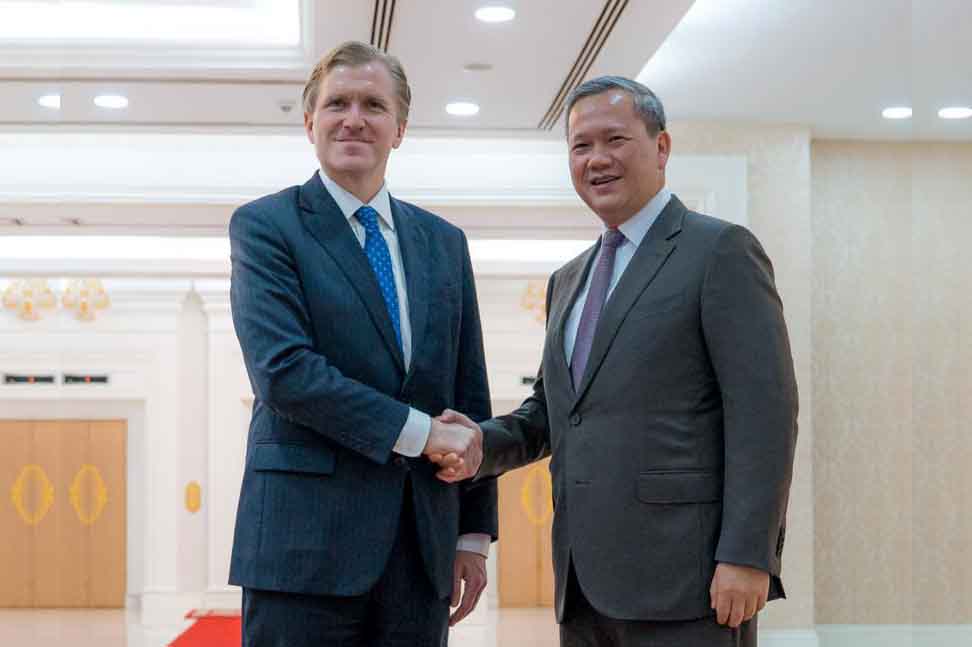
- The latest high-level engagement came on August 14, when U.S. Under Secretary of Defense for Policy Elbridge Colby met Prime Minister Hun Manet and reaffirmed stronger defense cooperation, marking a further step in rebuilding practical military-to-military relations.
Significance
- The U.S.–Cambodia economic relationship has developed over decades. What has changed is the security relationship. Washington’s previous restrictions, including the 2021 defense trade embargo, did not prevent China’s influence from expanding. The current approach reflects a more pragmatic calculation – continued disengagement risked reducing Washington’s influence without significantly limiting China’s engagement with Phnom Penh. U.S. policy is shifting from restriction toward engagement, with the objective of rebuilding practical defense cooperation and maintaining U.S. strategic relevance in Cambodia.
- Ream provides the clearest context for Cambodia’s strategy. At the inauguration of the modernized Ream Naval Base April 5, 2025, Prime Minister Hun Manet said that warships from all friendly countries are welcome, subject to the applicable conditions and prior notification. He also reaffirmed that Ream remains fully under Cambodian sovereignty and control and said that Cambodia will not allow any foreign military base to be established in Cambodia. This provides an important strategic context for the current defense reset. Cambodia is seeking broader international defense cooperation while keeping sovereignty, command and national decision making at the center. The policy allows Cambodia to cooperate with China while also welcoming legitimate U.S. and other naval engagement In this sense, Ream can serve as a practical demonstration of Cambodia’s multi-partner defense policy and strategic autonomy.
- Cambodia’s situation should not be viewed simply through the lens of U.S.–China competition. Across ASEAN, several member states maintain defense and security relationships with both Washington and Beijing, reflecting a broader regional strategy of diversification rather than alignment with a single major power. Cambodia is pursuing a similar multi-partner approach.
- Cambodia may not offer Washington the military capabilities of more advanced ASEAN defense partners, but its strategic value is different. Its location in mainland Southeast Asia, deep ties with China, the strategic importance of Ream and its willingness to expand practical defense cooperation with the United States give Washington an opportunity to preserve strategic engagement and maintain greater strategic choice in a place where Chinese influence is substantial. For Cambodia, the value extends beyond military equipment to defense expertise, professional military education, officer development, maritime cooperation, peacekeeping, humanitarian and disaster-response capabilities and transnational-crime cooperation.
Implications
- Cambodia maintains its close relationship with China while exercising its sovereign right to cooperate with other major powers. China remains deeply important to Cambodia’s investment, infrastructure, machinery, production inputs and defense cooperation. Stronger U.S. relations do not diminish that reality. However, having meaningful relationships with Washington and other partners gives Phnom Penh greater strategic room to maneuver.
- Does it give Cambodia leverage with Thailand, a neighbor with which Cambodia has a tense border dispute. Thailand is itself a longstanding U.S. security partner and maintains substantial defense cooperation with China. Cambodia should not expect Washington automatically to take its side in Cambodia–Thailand disputes. Instead, stronger U.S. engagement can increase Cambodia’s diplomatic visibility, deterrence, military-to-military communication and access to international security mechanisms. Cambodia can use this position to support peaceful border management, confidence-building, ASEAN engagement and respect for international law.
- The United States is currently balancing major military commitments in the Middle East with its Indo-Pacific strategy. This increases Washington’s incentive to develop capable regional partners that can contribute more to their own security. For Cambodia, this creates an opportunity to strengthen national defense capabilities through cooperation with the United States. For Washington, Cambodia can become part of a wider network of regional partners contributing to security without requiring the United States to carry the entire burden.
We will continue to keep you updated on developments in Cambodia as they occur. If you have any comments or questions, please contact BGA Cambodia Managing Director, Bora Chhay at bchhay@bowerasiagroup.com
Best regards,
BGA Cambodia Team

×