


















AI-Generated Content Labeling: An Indo-Pacific Overview
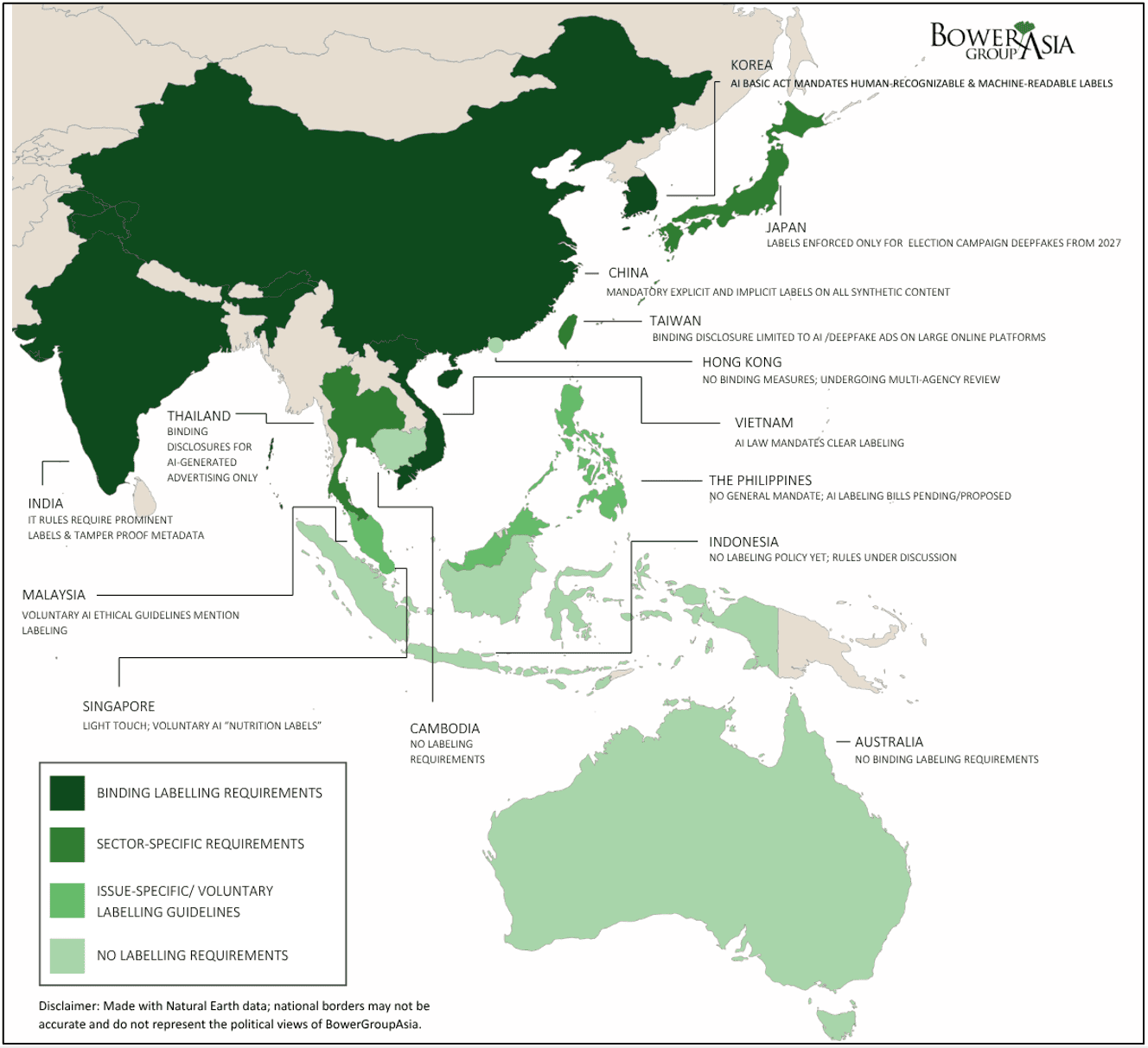
Among the emerging artificial intelligence (AI) governance frameworks in the Indo-Pacific, AI-generated content regulation remains a crosscurrent. Unlike broader AI policies, where regulatory convergence has been missing, labeling and watermarking of AI-generated media has emerged as the most common denominator across the region. Since 2025, several Indo-Pacific countries have introduced mandatory labeling requirements as the policy conversation around AI-generated media becomes subsumed within regulatory priorities on online safety, scam prevention and AI adoption across markets. The emergence and adoption of these regulations are often reactions to the negative social and political implications of increasing adoption of consumer AI applications.
However, framed constructively, labeling rules are not only a compliance obligation but an enabling layer for responsible AI adoption — which is a shared goal for both industry and governments across the Indo-Pacific. They give users clearer signals when content is synthetic, give governments practical tools to address scams, online harms, impersonations and election-related deception. They also give companies a credible basis to demonstrate that AI-enabled products can be deployed safely at scale. For businesses, this creates a fertile landscape to advocate for rules that are clear, risk-based, technically feasible and interoperable across markets, while still supporting the shared public-policy goals of transparency, trust and confidence in AI systems. The child online safety policy contagion has demonstrated governments’ willingness to learn from one another across the Indo-Pacific when policy enhances digital trust and safety. As a result, companies that are able to get ahead of the curve and proactively shape labeling regimes with governments can enjoy a competitive and reputational advantage across jurisdictions.
In reality, while AI-generated content labeling is moving from a speculative policy issue to an operational question, the Indo-Pacific remains far from harmonized. China, Korea, India and Vietnam now represent the environments with the most detailed, binding or near-binding requirements that combine user-facing disclosures, machine-readable identifiers, metadata or watermarking obligations. Taiwan and Thailand have adopted narrower sector-specific rules focused on online advertising, consumer protection or elections. Singapore, Japan, Malaysia and the Philippines still rely primarily on voluntary frameworks, targeted proposals or online-safety and election-related channels. Australia, Cambodia, Hong Kong and Indonesia remain largely guidance-led or in early rulemaking stages.
This divergence has implications for business efficiency because compliance responsibilities may fall on different agencies depending on the market, including AI developers, online intermediaries, advertisers, publishers, press agencies, election participants and companies deploying AI-enabled services. It also raises practical questions about whether labeling rules should rely on user-facing disclosures, machine-readable watermarks, metadata or other provenance tools and how those requirements should vary across text, image, audio, video and other media.
As AI labeling requirements become more concrete, executives face two complicated compliance options. First, a company may wish to adopt a “highest bar” approach, choosing to comply with the most stringent standard — for most cases likely China or India. However, such stringent regulations impose significant operational requirements and, where enforced, reputational risk challenges due to often short expected response times. Second, a company may wish to manage compliance on a market-by-market basis rather than through a single regional standard — an approach that duplicates compliance efforts and costs. While neither approach is the most efficient, businesses must develop an internal policy on transparency mechanisms for AI deployment and effectively articulate it with government stakeholders who are actively regulating AI-generated media. A strong narrative on this specific issue also allows companies to advocate for convergence toward labeling regimes that meet the governments’ priorities while balancing industry concerns and compliance costs.
The following section summarizes AI-generated content labeling and watermarking rules, proposals and guidance across major Indo-Pacific markets.
If you have any questions related to AI labeling discussions, please contact our technology team:
- Will Heidlage, Senior Director, Technology (wheidlage@bowergroupasia.com)
- Apoorva Kolluru, Director, Technology (akolluru@bowergroupasia.com)
- Heidi Mah, Director, Technology (hmah@bowergroupasia.com)
- Harris Amjad, Associate, Technology (hamjad@bowergroupasia.com)
- Lew San Hong, Associate, Technology (shlew@bowergroupasia.com)
AI-Generated Content Labeling Regulations
Australia
- The government’s National AI Plan confirmed in December 2025 that it will not pursue the mandatory guardrails or standalone AI Act proposed in September 2024, opting instead to rely on existing technology-neutral laws, sector regulators and voluntary guidance. The labeling- and watermarking-related “Guardrail 6” will not become a binding cross-economy requirement in the near term.
- The October 2025 Guidance for AI Adoption (AI6) replaced the 2024 Voluntary AI Safety Standard (VAISS) as the government’s primary voluntary framework and folds in labeling and watermarking guidance that had originally been slated for a standalone VAISS v2.
- The National AI Center and the Department of Industry, Science and Resources published “Being Clear about AI-Generated Content: A Guide for Business” in November 2025. It is a voluntary guide covering text, image, audio and video that recommends three transparency mechanisms (visible labeling, digital watermarking and metadata recording) to be applied in combination depending on risk level and the extent of AI’s contribution to the content.
- The Digital Transformation Agency’s mandatory technical standard for federal public service use of AI, requiring visual watermarks and metadata for AI-generated media and Web Content Accessibility Guidelines-compatible watermarking, remains unchanged and continues to apply to government agencies.
Cambodia
- Cambodia has not enacted a dedicated law regulating AI-generated content, with malicious use presently regulated under relevant criminal penalties for fraud and cybercrimes. Current policy direction is reflected mainly in the Draft National Artificial Intelligence Strategy 2025-2030 and the UNESCO AI Readiness Assessment, both of which emphasize responsible AI and stronger governance frameworks.
- The draft strategy outlines priorities including human capital, data and infrastructure, public-sector adoption, responsible AI and research collaboration. While it promotes transparency and trustworthiness, it does not require labeling of AI-generated content.
China
- Since China’s AI-generated content labeling rules took effect in September 2025, there have been no major new legal requirements or revisions to the core labeling framework, which continues to require both explicit and implicit labels for all synthetic content. Regulatory attention has shifted toward implementation and enforcement.
- The Cyberspace Administration of China (CAC) announced in April one of its first notable public enforcement actions under the AI-content labeling regime, penalizing three online platforms for failing to properly label AI-generated content.
- Enforcement measures included regulatory inquiries, rectification orders and formal warnings, with responsible individuals also facing penalties. The CAC stated it would strengthen oversight of AI-generated content labeling to curb misinformation and promote the healthy development of AI.
- China has expanded enforcement of AI labeling and compliance requirements through its 2026 “Qinglang” (Clearing) campaign. Since April, the CAC’s first-phase crackdown has targeted failures to comply with model registration requirements, inadequate AI safety and content-filtering reviews, data poisoning risks and insufficient labeling of AI-generated content.
- The CAC reported removing more than 14,000 noncompliant AI products (including websites, apps and AI agents), deleting over 6 million pieces of illegal content and suspending more than 26,000 accounts. The campaign demonstrates that AI content labeling is now being enforced as part of a broader AI governance regime rather than as a standalone obligation.
- China has already announced a second phase of enforcement, which will focus on AI-generated misinformation, impersonation, harmful content and violations involving minors. The CAC also stated it will increase penalties for noncompliant accounts and organizations and continue strengthening oversight.
Hong Kong
- Hong Kong has no binding AI-specific law on content labeling or watermarking. Its approach is voluntary and guideline-based and is not bound by China’s mandatory labeling regime, the Cyberspace Administration of China’s Measures for Labeling AI-Generated Content.
- The Digital Policy Office released the Hong Kong Generative Artificial Intelligence Technical and Application Guideline in April 2025 (updated to version 1.1 in December 2025), developed with the Hong Kong University of Science and Technology-based Generative AI Research and Development Center. The voluntary guideline recommends that technology developers label generated content to distinguish it; that service providers label generated images and videos and build in traceability and auditability mechanisms; and that service users disclose AI involvement via watermark, label, metadata or digital signature, particularly when content is published commercially or disseminated at scale.
- The guideline sets a higher bar for “high-risk” categories of generated content – explicitly naming deepfakes, ID document images and financial materials – recommending irremovable watermarks or embedded codes to ensure traceability and accountability, above the general labeling expectation applied to other generative content.
- In February 2026, Hong Kong’s Privacy Commissioner for Personal Data also co-signed a global Joint Statement on AI-Generated Imagery and the Protection of Privacy in February 2026 with 60 other data protection authorities, flagging risks from realistic AI-generated images and videos of identifiable individuals, though this is a position statement, not a binding labeling rule.
- Presently, Hong Kong authorities are undertaking a multiple-department review of legal and governance measures to address risks linked to artificial intelligence-generated synthetic content, with public consultations expected at a later stage of the review.
India
- India has moved from advisory-based guidance to binding law. In February, the Ministry of Electronics and Information Technology (MeitY) notified the IT (Intermediary Guidelines and Digital Media Ethics Code) Amendment Rules, 2026, effective February 20, which brings synthetically generated information (SGI), including deepfakes and other AI-generated or AI-modified audio, visual and audiovisual content, formally within the IT Rules’ due-diligence framework.
- Permitted (non-prohibited) SGI must now be “clearly and prominently” labeled. Visual content requires an on-screen label, and audio content requires a spoken disclosure at the start of the clip. Platforms must also embed permanent, tamper-resistant metadata or a unique identifier tracing the content to its origin and are barred from allowing labels or metadata to be stripped, modified or suppressed. An October 2025 draft had proposed a fixed threshold (labels covering at least 10 percent of visual surface area or the first 10 percent of audio duration); this specific numeric requirement was dropped from the final rules in favor of the principles-based standard.
- A further draft amendment circulated by MeitY in April proposes tightening this further to require “continuous and clearly visible display” of the label throughout the duration of visual content (rather than only at the outset). This remains a draft as of the time of writing and has not yet been formally notified.
- The new regime now supersedes as the operative standard the Election Commission of India’s January 2025 advisory requiring “AI-Generated” and “Synthetic Content” labels on political campaign material, and MeitY’s earlier IT Rules 2021 advisories. Platforms found in breach of the 2026 amendment risk losing safe-harbor protection and a compressed three-hour takedown window now applies to certain categories of unlawful synthetic content (for example, sexually explicit, defamatory and violence-inciting impersonation).
Indonesia
- The Ministry of Communication and Digital Affairs, the key regulator for digital issues, does not have an AI-labeling policy and therefore does not currently impose penalties for noncompliance.
- However, discussions are ongoing within the Coordinating Ministry for Political, Legal and Security Affairs about introducing mandatory AI content labeling. These discussions are still at a very early stage, with the ministry placing strong emphasis on the potential security implications of AI-generated content.
- Indonesia’s proposed Copyright Law changes may also require the disclosure of AI usage, although operational details remain unclear at present.
- Indonesia’s main AI governance instrument is Ministerial Circular No. 9 of 2023 on AI Ethics, which sets principles such as inclusivity, transparency, security, credibility and accountability. However, it serves primarily as ethical guidance rather than a binding AI law.
- Government planning documents for 2025-2029 include AI as a strategic priority, while the Ministry of Communication and Digital Affairs (Komdigi) has been developing a national AI white paper and formal regulatory framework. As of July, a draft presidential regulation on the 2025-2029 National AI Roadmap is awaiting approval. Proposed measures include AI-risk reporting requirements for public bodies, covering issues such as biometric misuse, intellectual property violations and deepfakes, but these are not yet binding.
Japan
- Japan continues to adopt a “soft law,” nonbinding approach to AI regulation, including its labeling requirements. In December 2025, Japan’s Artificial Intelligence Strategic Headquarters published guidelines for implementing the AI Promotion Act. The guidelines direct businesses to “strive to develop technologies that can determine whether something is generated by AI (digital watermarks, provenance management, APIs, etc.)” and implement them “as necessary.”
- Japan’s lower house passed its first binding AI-content labeling rule in June as amendments to its Public Offices Election Act and platform accountability law. Specifically targeting election deepfakes, this new rule will require AI-generated videos and images related to election campaigns (except for obvious synthetic content) to be labeled as “AI created.”
- The scope of the rule is limited to the election context, refers only to video and images and has not yet prescribed visible-label format requirements. The bill has cleared the upper house on July 13, and will become effective March 1, 2027.
Korea
- The Ministry of Science and ICT (MSIT) finalized the Enforcement Decree to the AI Basic Act in December 2025 and divides the AI-generated labeling obligation under Article 31(2) into two distinct methods: a human-recognizable method or a machine-readable marker. It further requires that machine-readable and metadata labels be paired with at least one human-facing text or voice notice. Article 31(3) sets a stricter, standalone rule for deepfake output. For deepfake content, only human-recognizable labeling (visible or audible) is permitted; the machine-readable option does not apply. Content that is obviously AI-generated (including via a label embedded in the output itself) is exempt under the enforcement decree’s exception clause.
- Separately, Article 31(1) imposes a prior-notice obligation, distinct from output labeling. This means any company that provides products or services using high-impact AI or generative AI must notify users before use that the product or service operates on that basis. This can be satisfied via terms of service, an on-screen notice or posted signage for offline services.
- MSIT published AI Transparency Guidelines January 21, one day before the act’s effective date, clarifying how these obligations apply in practice. Notably, the required labeling method depends on where the output lives (within the service versus exported externally). Content that stays within the service can be labeled through user interface elements or a persistent AI-disclosure logo. If the output is exported or shared externally (downloaded or shared files), it must carry the label on the output itself.
- The Act on the Development of Artificial Intelligence and Establishment of Trust (“AI Basic Act”) and the finalized Enforcement Decree entered into force January 22. The act applies only to “AI business operators” defined as AI developers and AI-using business operators (who offer AI products or services). Noncompliance may result in administrative fines of up to KRW 30 million ($20,200). However, the government has committed to a minimum one-year grace period focused on guidance rather than enforcement to allow businesses to adjust to compliance without penalty risk.
Malaysia
- Malaysia’s National Guidelines on AI Governance and Ethics (2024) are the country’s main AI governance framework. The voluntary guidelines are built around seven principles: fairness, transparency, accountability, privacy, safety, inclusiveness and human well-being.
- Malaysia does not currently impose a standalone AI-generated content labeling or watermarking requirement. Its National Guidelines on AI Governance and Ethics remain voluntary and emphasize transparency, accountability and responsible AI rather than specific labeling formats.
- The Online Safety Act 2025, in force since January 1, authorizes the Malaysian Communications and Multimedia Commission (MCMC) to operationalize platform duties through subsidiary regulations, codes and guidelines. The act is technology-neutral, but it provides the likely legal channel for future AI-generated or manipulated content disclosure requirements.
- The MCMC is rolling out subsidiary instruments under the act, and the Risk Mitigation Code reportedly requires covered platforms to adopt measures that help users identify AI-generated or manipulated content. The precise scope, format and enforcement mechanics for labels, watermarks, metadata or other identifiers remain subject to further MCMC guidance or rules.
Philippines
- The Philippines currently has no comprehensive binding law specifically requiring labeling or watermarking of AI-generated or synthetic content outside the election context.
- The Department of Information and Communications Technology (DICT) is piloting voluntary watermarking and detection systems with social media platforms and has listed AI regulation and development among its top legislative priorities. DICT plays a central role in advancing the Philippines’ digital transformation agenda and supporting the development of responsible artificial intelligence governance. However, it has not issued legally binding regulations specifically governing AI-generated content, such as mandatory labeling, watermarking or disclosure requirements. Instead, its initiatives primarily support institutional readiness and policy coordination while broader AI legislation and governance frameworks continue to be developed.
- Senate Bill No. 852, or the proposed Artificial Intelligence Regulation Act, seeks to establish the Philippines’ first comprehensive statutory framework for AI governance. The bill proposes creating a Philippine Council on Artificial Intelligence, adopting a risk-based regulatory approach, imposing transparency and accountability obligations on AI developers and deployers and prohibiting certain harmful AI practices. However, as of July, the bill remains pending before the Senate and has not been enacted into law.
- House Bill No. 3214, also known as the proposed Deepfake Regulation Act, was filed during the 20th Congress to address the growing risks posed by AI-generated synthetic media. The bill seeks to protect individuals from the unauthorized creation, distribution or use of deepfakes by recognizing individual rights over faces, bodies and voices. It would require individuals’ prior written consent before generating or disseminating AI-generated content that realistically replicates their likeness and provides legal remedies against unauthorized deepfakes. The proposal also introduces trademark-related protections and establishes penalties for malicious or deceptive uses of AI-generated media. As of July, however, House Bill No. 3214 remains a legislative proposal and has not been enacted into law.
Singapore
- Singapore generally adopts a light-touch regulatory approach, favoring guidelines over prescriptive rules to foster AI innovation while managing associated risks. To this end, Singapore currently does not have regulations mandating AI labeling or watermarking.
- Minister for Digital Development and Information Josephine Teo unveiled Singapore’s new Infocomm Media Development Authority-led AI app nutrition labels in March 2026, requiring disclosure of AI use, risks and testing. Teo has also floated the proposal of AI nutrition labels for chatbots, but operational details on this initiative remain limited. Complementing these efforts, Singapore has invested SGD 50 million (US$39 million) in the Center for Advanced Technologies in Online Safety (CATOS), established in May 2024 and hosted by the Agency for Science, Technology and Research. CATOS’ mandate includes developing and customizing tools to detect harmful content and evaluating technologies such as watermarking and content authentication.
- The Infocomm Media Development Authority is interested in promoting the wider adoption of content credentials, but concerns remain about ensuring ease of public use and understanding, strengthening security and preventing forgery. Consequently, this initiative is still at an exploratory stage and is not expected to see widespread implementation in the near term.
- The one binding rule to emerge sits specifically under election governance. The Elections (Integrity of Online Advertising) (Amendment) Act, which entered into force January 22, 2025, prohibits publishing or sharing deepfake content depicting election candidates during the active election period (triggered by the Writ of Election on April 15, 2025); it does not require disclosure labels.
Taiwan
- Taiwan enacted the Fraud Crime Hazard Prevention Act July 31, 2024. It remains the country’s most binding AI-content disclosure requirement, although it is limited to online advertising platforms and is not a broad AI-labeling framework. The act includes an AI-specific disclosure requirement under Article 31(1)(4), directing online advertising platforms to disclose directly on the advertisement whether the content uses deepfake or AI-generated technology. This requirement took effect January 1, 2025, and applies to platforms meeting a scale threshold determined by the Ministry of Digital Affairs, including Google, LY Corporation, Meta and TikTok.
- In terms of labeling requirements, Taiwan’s AI Basic Act (effective January 14) is largely nonbinding. It divides AI applications into two categories: high-risk and non-high-risk. Article 5(2) states that AI products or systems classified as high-risk should display warnings or precautions. However, the act does not currently establish detailed implementation requirements or direct penalties for noncompliance, leaving further obligations to future sector-specific regulation.
- Under Article 16 of the AI Basic Act, the Ministry of Digital Affairs (MODA) was tasked to develop the risk classification system. In July, MODA published the AI Risk Classification Framework. The framework outlines a four-step methodology for sector regulators to identify potential AI risks against common standards, assess their impact level and determine an appropriate response. For now, no sector-specific high-risk designations have been determined.
Thailand
- Thailand has one binding sector-specific labeling requirement. On July 18, 2025, the Office of Consumer Protection Board issued a notification, already in force, requiring businesses to display one of its approved disclosure phrases whenever AI is used to generate or materially edit advertising images or videos. The disclosure must be visible, audible or readable, depending on the medium.
- Beyond advertising, Thailand still has no binding AI law. The draft Principles for AI regulations has advanced with the Electronic Transactions Development Agency releasing a revised Draft AI Act July 2, for public hearing. The draft act includes mandatory AI content labeling and disclosures for deepfakes and chatbots, with developers required to implement identifying measures and platform operators required to ensure labels are appropriately displayed. Noncompliance might invite administrative fines of up to $90,000.
Vietnam
- Effective March 1, Article 11 of Vietnam’s Law on Artificial Intelligence 2025 (Law No. 134/2025/QH15) establishes Vietnam’s primary AI transparency and labeling requirements. According to the rules, providers must inform users when they are interacting with an AI system, AI-generated or manipulated audio, image or video content through a clear and easily recognizable label.
- The law also applies extraterritorially to foreign AI providers serving users in Vietnam. Penalties will be calculated as a percentage of global revenue. The government granted a one-year grace period for AI providers to reach full compliance (until March 1, 2027). This has been extended to September 1, 2027, for AI systems used in health, education and finance.
- The government issued Decree No. 237/2026/ND-CP in June, requiring press agencies to label AI-created or AI-edited journalistic content, including text, images, audio and videos. The decree permits the use of AI across newsroom activities such as reporting, editing and content distribution but places responsibility on press agencies to verify the accuracy and legality of AI-assisted content. It also requires outlets to establish internal review and risk-control procedures and prohibits the use of AI to create or disseminate false, misleading or otherwise harmful information.