















Australia and EU Deepen Trade and Security Ties
BGA Australia Managing Director Michael “Mick” McNeill and BGA Managing Director for Global Trade and Economics Nydia Ngiow prepared an update for clients on the free trade agreement and strengthened defense ties between Australia and the European Union.
Context
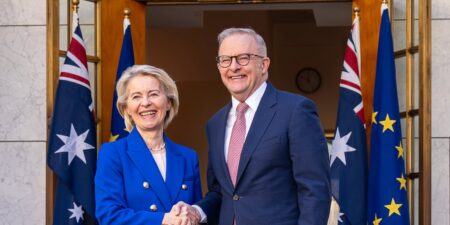
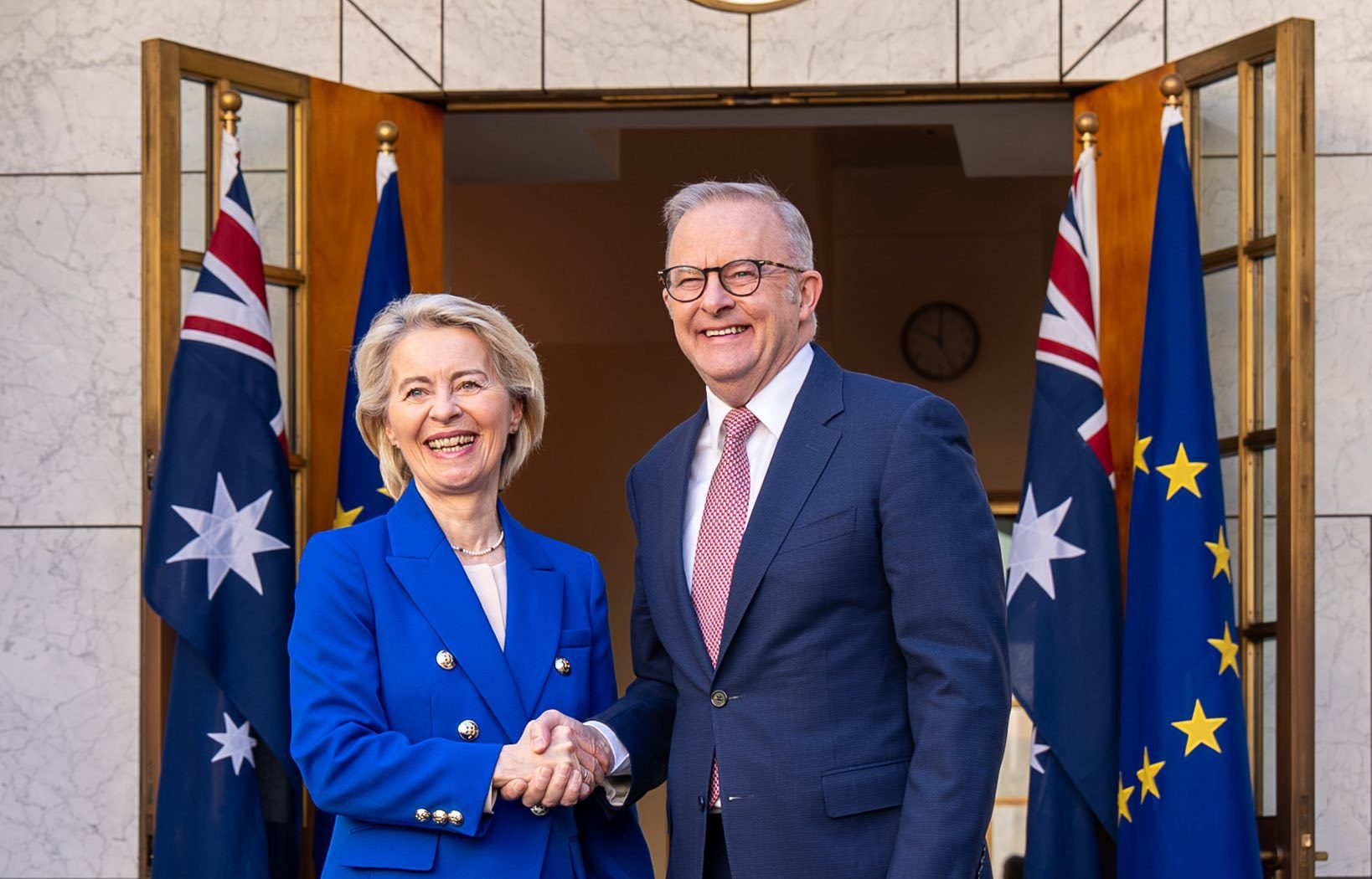
- Australia and the European Union concluded negotiations for a free trade agreement and signed a security and defense partnership March 24 as both look to strengthen supply chains, expand markets and resist authoritarian regimes. In her address to the Australian Parliament in Canberra the same day, European Commission President Ursula von der Leyen warned that economic “dependencies can be weaponized,” explicitly mentioning Russia and China. The ideological symbolism — Australia looking to the EU amid doubts about U.S. reliability — has given Prime Minister Anthony Albanese’s Labor base a sense of reassurance, but there will be no shift in the government’s view that the United States should remain Australia’s paramount security partner. Von der Leyen declared, “getting China right is a strategic imperative” and pointed to deepening Australian-EU critical minerals cooperation to reduce dependence on China. Referring to the defense and security partnership, she said, a “crisis in the Indo-Pacific would cripple global trade, directly hitting European industries and growth.” Both sides will also increase cooperation on maritime security, emerging and disruptive technologies, cyber security and countering hybrid threats and foreign interference.
- Australian and EU companies should expect a more favorable trade and investment climate, particularly in relation to critical mineral supply chains. The Australian government already has incentives to invest in critical minerals supply chains, such as the Critical Minerals Production Tax Incentive (which takes effect July 1, 2027) and the National Reconstruction Fund. Australian critical minerals are key to technology supply chains, as evinced by Australia’s participation in the U.S.-led Pax Silica initiative, launched in December 2025 among 13 economies to ensure artificial intelligence and supply chain security.
Significance
- Albanese and von der Leyen announced the conclusion of negotiations on the Australia-European Union Free Trade Agreement and will now start their respective domestic processes in the lead-up to signing the agreement. Trade Minister Don Farrell said, “This is a strategically important and economically valuable agreement at a time when Australian exporters are navigating choppy trade waters.” The agreement will be further scrutinized when its text is published. It will result in 98 percent of the current value of Australia’s goods exports entering the European Union duty free.
- A long-standing sticking point in the trade negotiations was increased market access in Europe for Australian agricultural products such as beef, mutton and sugar. This was addressed by new or expanded tariff rate quota volumes, although they still did not meet the expectations of the Australian National Farmers Federation, which slammed the “extremely disappointing” and “subpar” deal. Australia nevertheless secured flexibilities that allow Australian businesses and producers to continue using terms such as prosecco wine, kransky sausage and parmesan cheese. These are geographical indicators that the EU typically protects.
Implications
- Australian farmers and businesses will stand to benefit from cheaper motor vehicles and machinery from the EU. The agreement introduces a new luxury car tax category with a threshold of AUD 120,000 (US$84,500) for zero-emissions vehicles. Currently, the 33 percent luxury car tax kicks in at AUD 91,387 ($63,500) for fuel-efficient vehicles. Australia does not manufacture automobiles
- All Australian exports of mineral resources will face zero tariffs in the EU. The Australian government agreed to avoid a dual pricing structure, ensuring European firms can buy critical minerals on a level playing field with other international customers. The Minerals Council of Australia said the agreement encouraged increased EU investment into Australian mining projects, downstream processing and critical minerals supply chains. This would also support the facilitation of EU capital to fund critical minerals projects, with von der Leyen announcing increased cooperation in four major projects covering the production of rare earths, lithium, and tungsten. Australia and the EU will eliminate tariffs on environmental goods, including energy-efficient products, renewable energy technologies and batteries. The agreement does not include any commitments on carbon border adjustments or deforestation
If you have any questions or comments, please reach out to BGA Australia Managing Director Michael “Mick” McNeill at mmcneill@bowergroupasia.com or BGA Managing Director for Global Trade and Economics Nydia Ngiow at nngiow@bowergroupasia.com.
Best regards,
BGA Australia Team

×