


















Côte d’Ivoire’s Institutional Consolidation Signals Continuity and Stability
The BGA Côte d’Ivoire Senior Adviser Fabienne Diouf and Adviser Aminata Dia, wrote an update to clients on the country’s new phase of institutional consolidation.
Context
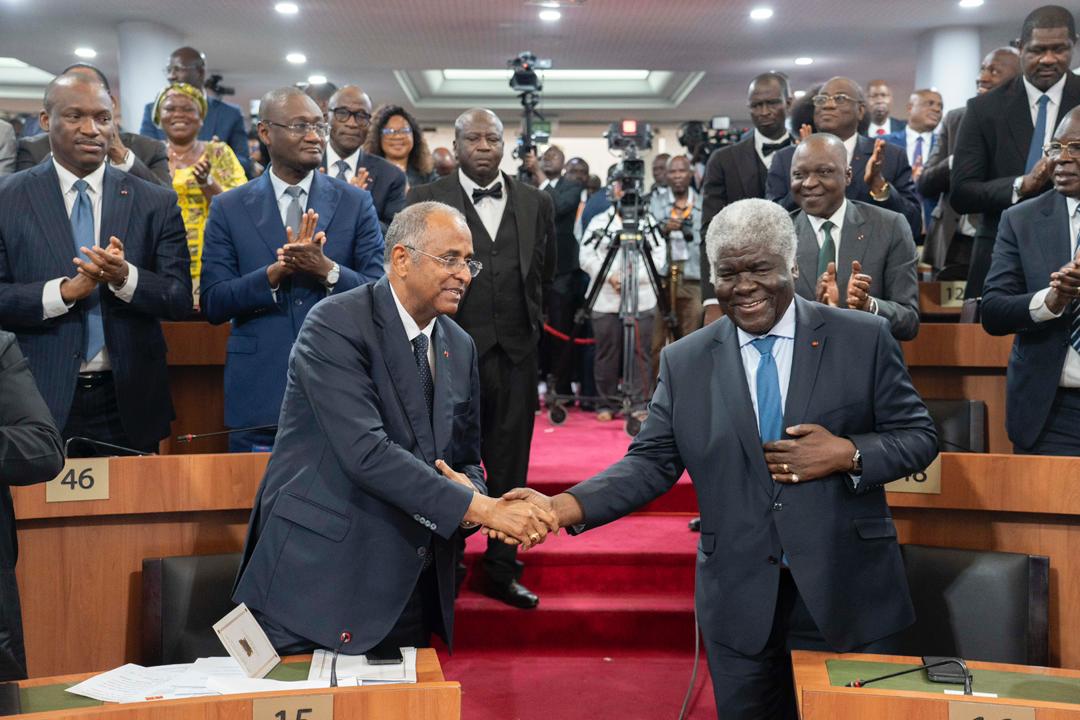
- Côte d’Ivoire entered a new phase of institutional consolidation from January 21-23 following the reappointment of Prime Minister Robert Beugré Mambé, and the election of former Prime Minister Patrick Achi as speaker of the National Assembly for the 2026-2030 legislative term. These developments follow the December 2025 legislative elections and underscore a deliberate effort by President Alassane Ouattara to reinforce executive-legislative alignment and preserve policy continuity during a sensitive political cycle.
- This development reflects the political system’s prioritization of control, continuity and delivery. For external companies and stakeholders, understanding where authority is concentrated and where it is intentionally limited is now more important than tracking individual personalities. BGA will continue monitoring how this consolidation translates into sector-level decisions and company access.
Significance
- The consolidation sends a strong signal of continuity at the executive level. The reappointment of Prime Minister Mambé confirms the president’s preference for stability over experimentation, particularly as the administration focuses on the delivery of ongoing economic and infrastructure programs. The move also reduces uncertainty around near-term policy direction and limits internal competition within the executive.
- The Cabinet reshuffle, rather than signaling political rebalancing, appears designed to optimize execution capacity in priority sectors while maintaining trusted political relationships. Announced January 23, the new Cabinet retains most incumbent ministers, especially across strategic portfolios:
- Economy, Finance and Budget.
- Mines, Petroleum and Energy.
- Infrastructure and Road Maintenance.
- Agriculture and Rural Development.
- Digital Transition and Innovation.
- The strategic significance of Achi’s election as speaker of the National Assembly by an overwhelming majority is a key signal. While no longer in the executive, Achi remains firmly inside the inner circle. He is now positioned as a stabilizing force within the legislature, a bridge between executive priorities and parliamentary execution and a guardian of institutional discipline as legislative agendas accelerate. This move strengthens the ruling coalition’s ability to pass priority legislation and budgets with minimal friction.
- Overall, the configuration suggests power consolidation rather than redistribution.
- Who’s in: Long-standing technocratic figures with proven delivery records, ministers overseeing capital-intensive and politically sensitive sectors and Institutional actors aligned with continuity, discipline and execution.
- Who’s out (or contained): Potential internal challengers who might have used the reshuffle momentum to renegotiate influence as well as reformist or disruptive figures not aligned with the current delivery-first phase.
Implications
- The new composition bears several notable implications for businesses and political risk:
- High policy predictability (short-to-medium term): Investors and partners can expect continuity in regulatory frameworks and sectoral priorities, particularly in infrastructure, energy and extractives.
- Acceleration of priority projects: With institutional alignment reinforced, project approvals, budget execution and administrative follow-through will likely improve.
- Lower risk of institutional gridlock: Executive-legislative coherence reduces the likelihood of delays caused by parliamentary resistance or internal fragmentation.
- Companies should continue to monitor the following signposts:
- The issuance of ministerial decrees of attribution, which may clarify real power distribution behind formal titles.
- Early legislative priorities under Achi’s speakership.
- Signals of succession management as the political calendar advances.
We will continue to keep you updated on developments in Côte d’Ivoire. If you have questions or comments, please contact BGA Côte d’Ivoire Senior Adviser Fabienne Diouf or Adviser Aminata Dia.
Best regards,
BGA Côte d’Ivoire Team

×