
















Indonesia and US Sign Trade Deal, Marking Sweeping Effort to Rollback Trade and Investment Frictions
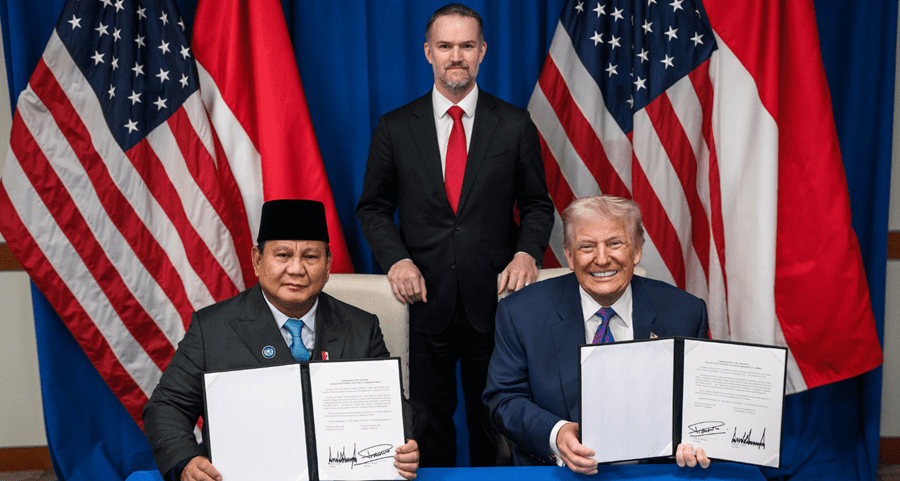
The BGA Indonesia team, led by Managing Director Douglas E. Ramage, wrote an update for clients on the Indonesia and US Agreement on Reciprocal Trade (ART) from February 19, 2026
Context
- Indonesia and the United States signed an Agreement on Reciprocal Trade (ART) in Washington, DC, February 19. The agreement confirms the 19 percent tariff rate applied to Indonesian exports to the United States and was concluded during President Prabowo Subianto’s visit to Washington for the inaugural Board of Peace meeting, following some uncertainty over whether the deal would be finalized during the trip.
- Like the ARTs that the United States has signed with Malaysia and Cambodia, this 45-page agreement goes far beyond tariffs. It represents a sweeping attempt to unwind non-tariff barriers and investment frictions that have long shaped, and in many cases constrained, U.S. companies and U.S. goods in Indonesia. If implemented as written, it would mark a meaningful shift in the operating environment for U.S. firms in Indonesia. The key question now is how these commitments are reflected in implementing regulations.
Significance
- Both the Indonesian and U.S. governments have framed the business-to-business signing ceremonies held the evening prior to the ART signing (hosted by the US-ASEAN Business Council, the U.S. Chamber of Commerce and U.S.- Indonesia Society) as contributing to Indonesia’s previously announced purchase commitments under the deal, including $15 billion in U.S. energy commodities, $13.5 billion in commercial aircraft and aviation-related goods and services (including from Boeing) and $4.5 billion in U.S. agricultural products.
- With the ART signed, Indonesia’s House of Representatives (DPR) will now take up the ratification process. BGA’s current assessment is that Indonesian ratification is likely in the second half of 2026, reflecting both the scope of the agreement and the political uncertainty surrounding it. On the U.S. side, no new legislative action is required because the agreement is implemented pursuant to existing presidential executive authority without the need for congressional approval or implementing legislation. In either case, ratification alone will not translate directly into execution
Implications
- Indonesia will exempt U.S. industrial goods and companies from local content requirements, accept U.S. goods that meet U.S. or international standards without additional testing, and provide broad exemptions from halal certification and labeling. It will also recognize FDA approvals, accept U.S. motor vehicles and parts without additional domestic approval, and stop using import licensing as a restrictive tool, while improving customs processes through pre‑arrival processing, paperless trade and binding advance rulings.
- On the digital and services side, Indonesia commits not to impose customs duties on electronic transmissions or digital services taxes, to facilitate cross‑border data transfers, and to prohibit technology transfer requirements. It will allow U.S. payment networks to operate without financial data localization, grant a cabotage exemption for subsea cable installation, remove foreign ownership restrictions in key sectors, and strengthen regulatory transparency and predictability through advance publication, consultation and review of rules.
We will continue to keep you updated on developments in Indonesia as they occur. If you have any comments or questions, please contact BGA Indonesia Managing Director Douglas E. Ramage at dramage@bowergroupasia.com
Best regards,
BGA Indonesia Team

×