















Myanmar Junta Turns Battlefield Gains Into Diplomatic Legitimacy
BGA Senior Adviser Dr. Thitinan Pongsudhirak wrote an update on Myanmar’s growing diplomatic recognition.
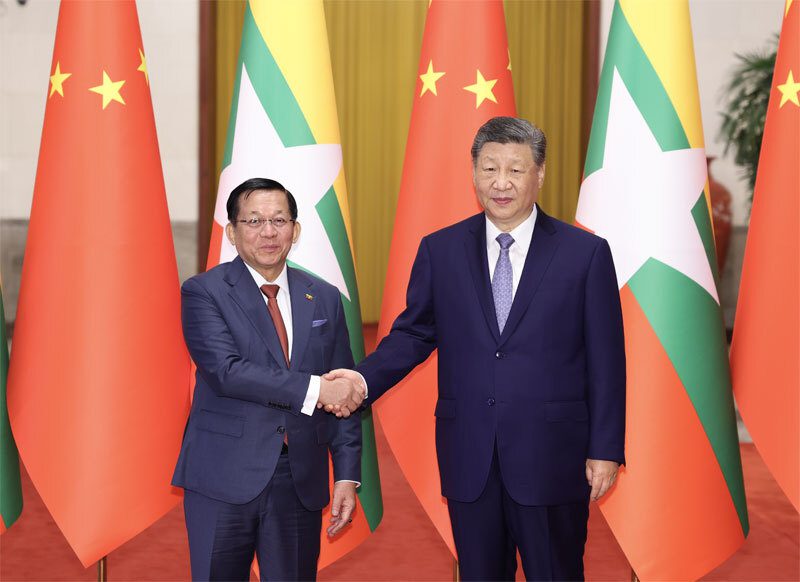
Senior Gen. Min Aung Hlaing has entered a new phase of his campaign to consolidate power more than five years after Myanmar’s military seized power February 1, 2021. The coup leader who not long ago faced nationwide resistance and international isolation is on the move. After ramming through shoddy elections with patchy electoral participation last December and January, he now dons civilian garb as post-election president and was received on official visits by Indian Prime Minister Narendra Modi and Chinese President Xi Jinping in June. With a similar state visit to Laos in early July and prospectively to Thailand in August, Min Aung Hlaing is converting battlefield advantages into diplomatic recognition and international legitimacy.
To be sure, Myanmar’s civil war is far from over. Resistance forces continue to fight across large parts of Myanmar’s borderlands, and the vast majority of Myanmar people remain opposed to Min Aung Hlaing’s military-backed post-election government. Yet the decisive turning point in the conflict may have passed. The military has survived its existential challenge, regained the strategic initiative, and is now leveraging that advantage to restore its standing in the Association of Southeast Asian Nations (ASEAN) and more broadly.
Until recently, such an outcome appeared improbable. Unlike the coups of 1962 and 1988, the military’s latest takeover was met with unprecedented nationwide resistance. The civilian-led National Unity Government (NUG), People’s Defense Forces (PDFs) and an array of ethnic armed organizations (EAOs) mounted a sustained challenge to Myanmar’s military. From roughly October 2023 to the middle of 2024, coordinated resistance offensives had overrun military positions, seized extensive territory and brought the fighting closer than ever to the military’s traditional strongholds in Naypyitaw, Mandalay and Yangon.
At that point, the military appeared vulnerable and about to be toppled by resistance forces. Yet the resistance failed to seize its moment. While it had military momentum and overwhelming moral legitimacy, the resistance never developed sufficient political coherence and boldness to convert battlefield gains into an alternative governing authority. With PDF units of armed youth fighters, who grew up during the decade of reform prior to the coup, and EAOs taking the battle to the coup regime, the resistance needed a political offensive and assertive leadership that the NUG could not muster.
The NUG remained organizationally fragmented and struggled to project unified leadership both domestically and internationally. Thousands of young fighters continued risking their lives, but battlefield advances outpaced political organization. The resistance lost not because it lacked courage or public support but because it failed to transform battlefield success into political authority that could supplant Min Aung Hlaing’s junta known as the State Administration Council.
As the NUG dithered while the EAOs and PDFs were unable to deliver the knockout blow, Beijing stepped in decisively. Throughout much of the conflict, China pursued a careful balancing strategy. It maintained working relations with Min Aung Hlaing and the junta while not ignoring the NUG and preserving links with several ethnic armed organizations operating along Myanmar’s northern frontier. Such pragmatism reflected China’s extensive interests in pipelines, ports, mining projects and border stability. Beijing was reluctant to alienate whichever side ultimately prevailed.
Once Chinese leaders concluded that the resistance did not have what it took to overcome the military, that calculus changed. Concerned by growing instability and the prospect of a fragmented and ungovernable Myanmar, Beijing exerted pressure on several ethnic armed organizations to step back and let the coup regime retake key territories, starting with Lashio in northern Shan state. The resulting breathing space enabled the junta to regroup, reinforce its positions and regain the battlefield initiative. Combined with Russian military assistance, compulsory conscription and continued access to state resources, Chinese intervention tipped the strategic balance.
Without Beijing’s shift, the military could still survive but not win; with Beijing’s support, Min Aung Hlaing was able to reassert control of the political trajectory. The tightly managed elections in December-January were the next step in that strategy. Widely criticized as neither free nor fair, they excluded meaningful opposition and failed all democratic and electoral standards. But these elections were not about the restoration of democracy; they were about political consolidation.
By exchanging his military uniform for a presidential office under a carefully managed civilian facade, Min Aung Hlaing has sought to transform himself from coup leader into head of state. While the elections did not confer popular legitimacy, they accomplished a key goal for him and provided governments seeking renewed engagement with a convenient procedural justification. Having secured his position at home, Min Aung Hlaing’s outward turn toward India, China, Laos and Thailand will likely expand into demands to reclaim Myanmar’s ASEAN chairmanship and seat at the United Nations, currently held by an ambassador from the pre-coup National League for Democracy-led government under Aung San Suu Kyi. In short, Min Aung Hlaing is trying to turn military survival into regional acceptance, political recognition and eventually international legitimacy.
This changing diplomatic landscape presents ASEAN with a daunting dilemma. For more than five years, the Southeast Asian bloc has relied on its five-point consensus (5PC) as the principal framework for addressing Myanmar’s conflict. Despite having signed it, Min Aung Hlaing has ignored 5PC commitments while ASEAN has remained divided over how to respond. Now that Laos, Thailand and other member states are likely to engage the post-election Min Aung Hlaing-led government, ASEAN must be careful not to do so too soon without concessions.
For example, if it is later discovered that Aung San Suu Kyi is not alive and safe, ASEAN could lose credibility and centrality among major external partners except China and Russia. If anything happens to her under Min Aung Hlaing’s watch, the ASEAN-centered summits later this year and next year may be boycotted by major world leaders. Similarly, as many thousands of Myanmar people have been killed and maimed by the junta government over the course of the civil war, the reentry of Min Aung Hlaing could deter attendance for a range of ASEAN’s external dialogue partners.
Meanwhile, if the resistance forces intend to put a stop to the military-backed government’s gathering momentum, they would need to shift battlefield directions and soon turn the tide of the civil war in their favor, including a complete overhaul of the NUG leadership and replacement with younger faces who are doing the actual fighting inside the country. For the business sector, the ground is quickly, and fundamentally, shifting in the Myanmar government’s favor. Unless current trends are somehow reversed, the military-backed government’s military initiative, political consolidation, and regional recognition are likely to signal that business is back (see BGA’s April 16, 2026, update, “Myanmar’s Delayed Fait Accompli: Old Wine in an Old Bottle”).