















Xi, Trump and Putin: A Fluid Geostrategic Chessboard
GA Senior Adviser Dr. Thitinan Pongsudhirak wrote an update on the Indo-Pacific’s geostrategic landscape.
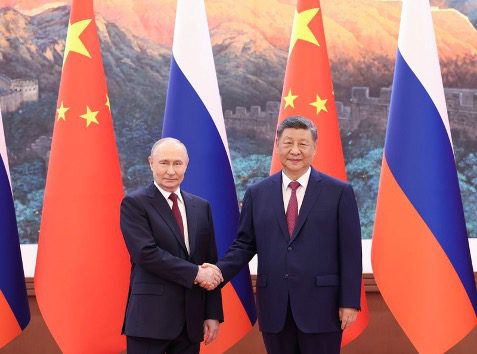
More geostrategic roads are now leading to Beijing. Russian President Vladimir Putin’s visit to the Chinese capital this week and his summit with President Xi Jinping should be viewed alongside — and in contrast to — U.S. President Donald Trump’s similar trip less than a week earlier. Amid rapid shifts on the global chessboard, China under Xi has emerged as the pivotal player above all others. Russia needs China’s backing to sustain its war effort in Ukraine and secure a workable settlement. Trump, meanwhile, needs Xi’s cooperation to pressure Iran over uranium enrichment, Tehran’s blockade threats in the Strait of Hormuz amid Washington’s own restrictions on Iranian shipping on the same waterway. China is now the senior partner in its relationship with Russia and the principal patron of Iran. Beijing’s geostrategic leverage has rarely been greater.
What is unfolding at this juncture is profound, comparable only to two earlier inflection points over the past 80 years. One was the U.S. strategic opening to China to counter the Soviet Union, culminating in President Richard Nixon’s 1972 visit to Beijing. The other was the fall of the Berlin Wall in 1989 and the subsequent collapse of the Soviet Union in 1991, ending the Cold War. The great-power realignments now underway could reshape the international system for years to come.
Until recently, global order revolved largely around how the United States shaped and upheld the rules, norms and institutions underpinning it, in coordination with allies and partners. But the second Trump administration has upended much of that eight-decade-old architecture, opening unprecedented space for China to shape outcomes instead. This shift was on display during Trump’s recent Beijing visit. Delayed from March 31 because of the escalating Iran conflict that began on February 28, the May 13-14 trip reinforced efforts to stabilize the trade and technology rivalry after Trump and Xi met previously in Busan last October.
Trump’s miscalculated joint strike with Israel against Iran — widely seen as violating international law and the U.N. Charter — has further eroded the United States’ already diminished moral authority. When the chief architect, underwriter and guarantor of the global order appears willing to disregard and discard it, the system naturally drifts toward self-help, with states scrambling to hedge, realign, multi-align and forge new partnerships for survival.
For China, however, the challenge is not merely survival but strategic opportunity. Xi’s welcoming remarks to Trump were revealing. As the Chinese president put it, “The world is at a crossroads. Can China and the United States transcend the so-called ‘Thucydides trap’ and forge a new paradigm for major-power relations? … Can the United States and China create a new paradigm of relations to meet these global challenges together?”
Xi’s framing echoed Beijing’s rhetoric from 2013, shortly after he assumed power, when China promoted the notion of “a new type of great-power relationship.” At the time, Beijing implied that China should be recognized as a geopolitical peer of the United States, dominant in some spheres while accepting continued U.S. primacy in others. Thirteen years later, the proposition appears more ambitious. China is no longer signaling partial parity but full co-equality across the board.
Xi’s remarks in Beijing amounted to a proposition for mutual accommodation and tacit spheres of influence, wrapped in the language of “a constructive China-United States relationship of strategic stability.” His invocation of the Thucydides trap — in which a rising power displaces a declining one — was deliberate. Beijing has clearly thought through the kind of bilateral order it prefers. Unsurprisingly, Xi also reiterated China’s red line over Taiwan.
Trump avoided mentioning Taiwan publicly during the summit but later implied that the democratic island could become a bargaining chip in negotiations with Beijing. While this stance unsettled Taipei, Trump sought to reassure Japan by calling Prime Minister Sanae Takaichi after leaving China, though the exchange appeared largely perfunctory. Much now depends on subsequent meetings, including Xi’s expected White House visit in September and the Asia-Pacific Economic Cooperation summit China will host in November.
Unlike Trump’s visit, Putin’s trip proceeded smoothly and reaffirmed the durability of China-Russia ties on the 25th anniversary of their bilateral cooperation treaty. Both sides emphasized a “multipolar world order” and criticized U.S. unilateralism and “irresponsible” security policies. Beijing has again positioned itself as the responsible adult in the room — mediating conflicts rather than provoking them. One major strategic gain for China from the Russia-Ukraine war is that Moscow now accepts its subordinate role in the partnership. Xi also appeared intent on reassuring Putin that ties with Russia would remain steady despite his parallel engagement with Trump.
China now holds more geostrategic cards than the United States. The “strategic stability” emerging from Xi’s summitry with both Trump and Putin will be tested in the months ahead. But Beijing’s broader objective is becoming clearer, not merely to compete with Washington, but to secure U.S. acceptance of a de facto G2 (Group of Two) order in which the world’s two dominant powers accommodate each other’s core interests and spheres of influence. If Trump rejects that proposition, relations could again turn unstable and adversarial.
Business should be cognizant of these geostrategic trend lines. Business operations and supply chains will not cease or disappear, but they will need to adjust and adapt. They will likely become more fragmented and costly as geostrategic dynamics and determinants become fluid and volatile. As economic security and state survival trump market efficiency and profit margins, firms will need to think more like states.
We will continue to keep you updated on developments in the Indo-Pacific. If you have comments or questions, please contact BGA Senior Adviser Thitinan Pongsudhirak at thitinan@bowergroupasia.com
Best regards,
BowerGroupAsia