


















US SecDef Hegseth’s Call to Arms: A Shangri-La Dialogue Post-Mortem
BGA Senior Adviser Dr. Thitinan Pongsudhirak wrote an update to clients on the Shangri-La Dialogue.
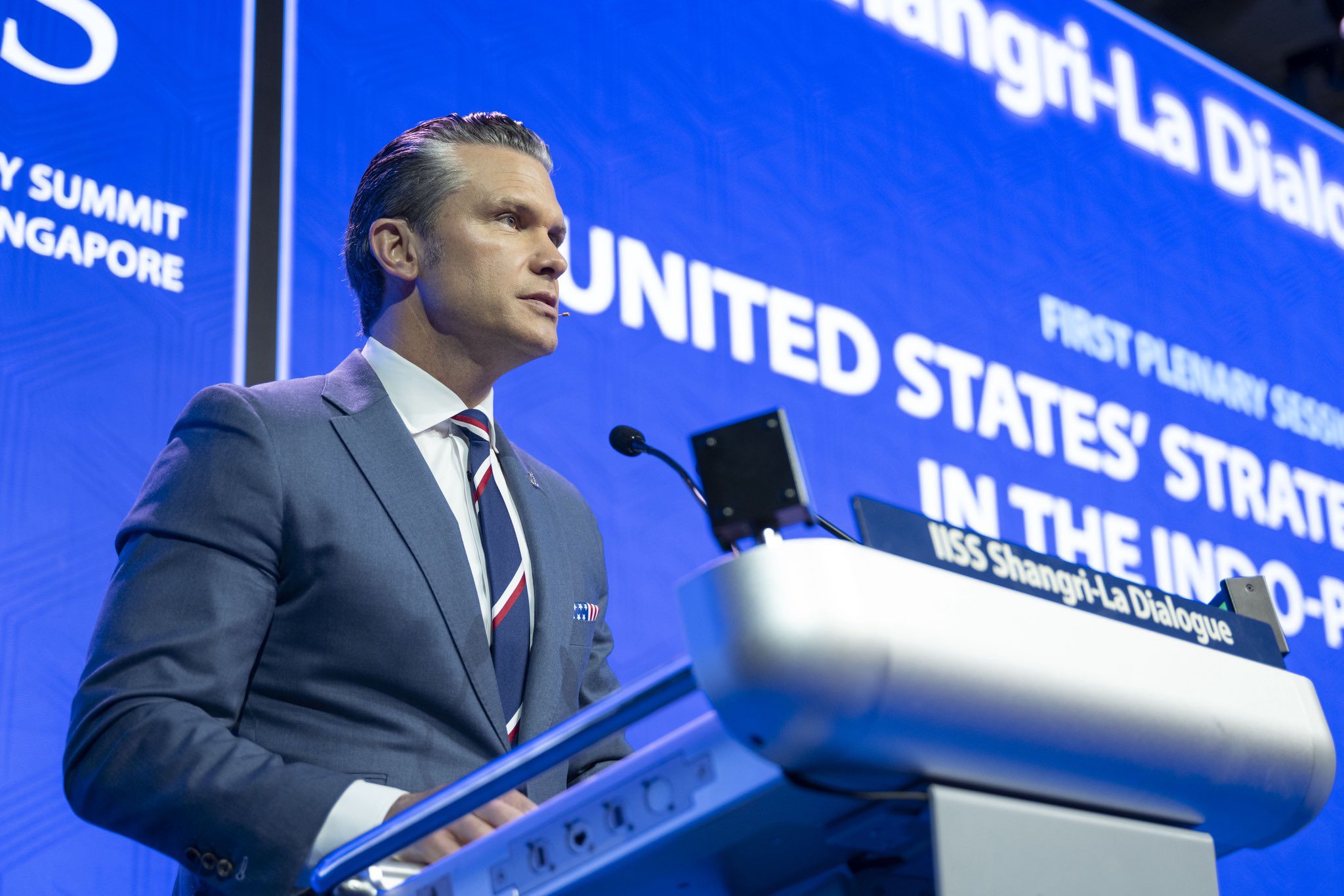
U.S. Defense Secretary Pete Hegseth’s demand at the recent Shangri-La Dialogue in Singapore that Asian allies and partners spend 3.5 percent of GDP on defense should concern not only policymakers but also business leaders and investors. His forceful push for increased military spending among the United States’ Asian allies and partners will likely lead to a defense buildup not seen in decades. It bodes ill for regional security in Southeast Asia and threatens to undermine the economic foundations that have made the region one of the world’s most dynamic growth engines. Nor does it seem to add up given United States’ own debt and defense concerns.
Under the 11-member Association of Southeast Asian Nations (ASEAN), the regional neighborhood south of China and east of India has succeeded in securing peace and security for the past six decades as the anchor of broader Asia by design and by default. No other organization can convene Indo-Pacific countries large and small the way ASEAN has done through its annual meetings, such as the East Asia Summit. Notwithstanding its shortcomings and internal divisions, ASEAN needed to take a leading role in security promotion and maintenance because no other entity is as widely trusted to fulfill this function. ASEAN’s role as the buffer, bridge and broker in keeping the bigger powers connected and away from confrontation and conflict is a central feature of the region’s strategic environment. Just as importantly, this stability has enabled decades of trade, investment and manufacturing growth that have transformed Southeast Asia into a key node in global supply chains.
Southeast Asia’s approach to peace and security has been to promote diplomacy over force. It has been about “jaw-jaw” over “war-war,” a Churchillian quip often repeated in ASEAN contexts. Hegseth, in fact, chastised this approach at the Singapore gathering. As he put it, “We don’t need more conferences. We need more combat power … less Shangri-La, more ships, more subs.” As he likens himself to the “secretary of war,” who oversees a gargantuan war-fighting government department, Hegseth’s call for a defense buildup risks spiraling into an arms race in Southeast Asia, a region with historical enmities and overlapping territorial claims. Such an outcome would raise geopolitical risk in a region whose attractiveness to global business has long rested on relative peace and predictability.
Southeast Asia’s regional defense spending averages less than 2 percent. This means the 3.5 percent benchmark would require Indonesia, Malaysia, the Philippines and Thailand to more than double their current annual defense expenditures. Others, such as Singapore and Vietnam, face smaller but still considerable gaps. Myanmar is the only ASEAN member state already above the target at 4.2 percent. Its arsenal of artillery and airstrikes has been aimed exclusively at its own people who have fought a fierce civil war against Myanmar’s military, which staged a coup in February 2021 and has whitewashed it with a sham election earlier this year. In a region where militaries have played an outsized role in politics, higher defense budgets will play into the hands of the top brass at the expense of civil society organizations and democratization.
Since the 1980s, Southeast Asia has focused on trade and investment to become a manufacturing powerhouse, resulting in phenomenal economic development and contributing to global economic expansion. Hegseth’s demand would require the reallocation of resources from critical sectors, such as infrastructure, health, education and workforce development, to boosting arms acquisitions and defense industrial bases at a time when Southeast Asia’s export-led growth models face headwinds from the tariffs of President Donald Trump and U.S. protectionism against the backdrop of an adverse world economy and energy shock from the conflagration of the Iran war and wider conflict in the Middle East.
Every dollar diverted into accelerated military procurement is a dollar not invested in the physical and human capital that underpins long-term competitiveness. The pressure and pain points on economic growth could result in domestic political instability in Southeast Asian countries. The rich would become richer, the poor poorer still, with fewer safety nets and welfare cushions. Slower growth and fiscal strain could undermine investor confidence and increase political risk across a region that multinational companies increasingly view as a preferred destination for supply chain diversification.
Domestic instability could spill over into regional risks as incumbent governments may resort to nationalism against neighbors (potentially Thailand and Cambodia) to divert attention or to face internal dissent and protests as economic conditions worsen. The shakeup in the region from lower growth and higher spending on defense and less on physical and human infrastructure amid an unprecedented arms buildup would undermine regional unity and cohesion. In such dire straits, Southeast Asian countries would be pushed further into China’s geostrategic orbit.
All of this does not mean Southeast Asia should be “freeloading,” as the U.S. defense secretary referenced, on Washington as an offshore security balancer regarding China. Yet Southeast Asian countries deploy diplomacy and defense in a moving mix to address their threat perceptions. They have engaged and included China, for example, in a clutch of regional bodies, including the Regional Comprehensive Economic Partnership for trade liberalization and the ASEAN Defense Ministers’ Meeting-Plus, apart from the East Asia Summit. The latter two also include the United States. Economic and defense diplomacy and cooperation are part and parcel of how Southeast Asia spends on defense.
Much of the “freeloading,” in fact, was to America’s benefit because it helped maintain domestic political stability, economic growth and social development while enabling Washington to reign supreme in the rules-based international system. In their own constellations of power and prestige, the great powers usually allow some freeriding because they need the smaller states to play along. Granted, the 3.5 percent is probably not a strict benchmark and will likely be considered with other conditions, such as defense spending increases and military to military cooperation with the U.S. joint force. To be sure, freeloading is inherent in any system dominated by a great power.
And Hegseth’s numbers do not seem to add up. If the United States wants partners and allies to increase defense spending to carry their load, it should seek a “burden-sharing” dividend whereby its defense budget can be reduced. Instead, the U.S. Department of Defense wants to increase its budget from $1 trillion to $1.5 trillion in the coming fiscal year. The whopping 50 percent hike would put U.S. military expenditures above those of the nine next largest militaries combined, or 44 percent of all military spending worldwide. Such a military boost would exacerbate Washington’s ballooning $39 trillion debt.
It would also raise the question about the nature and identity of the threat and enemy. As its most recent National Security Strategy and National Defense Strategy laid out, Washington under Trump’s second term aspires to dominate the Western Hemisphere, although the Iran war has proved costly and distracting to its core aims. If partners and allies are to spend a lot more on defense while the United States does the same, to what end will these expenditures end up, especially when Trump and Chinese President Xi Jinping have recently reinforced guardrails in U.S.-China relations?
For businesses operating in Asia, the key question is not whether Southeast Asia should spend more on defense but whether the pace and scale being demanded will strengthen or weaken the economic foundations of regional stability. The region’s attractiveness has long depended on political stability, open trade, manageable geopolitical tensions and sustained investment in development. A rapid military buildup that diverts resources from these priorities could erode the very conditions that made Southeast Asia a manufacturing hub, investment destination and growth engine in the first place. This is why Hegseth’s proposition is not only ominous and dangerous but also economically risky.
We will continue to keep you updated on developments in the Indo-Pacific. If you have comments or questions, please contact BGA Senior Adviser Thitinan Pongsudhirak at thitinan@bowergroupasia.com
Best regards,
BowerGroupAsia