
















Singapore Forecast: AI Momentum and Policy Stability Offset Mounting Global Risks

WHAT YOU NEED TO KNOW
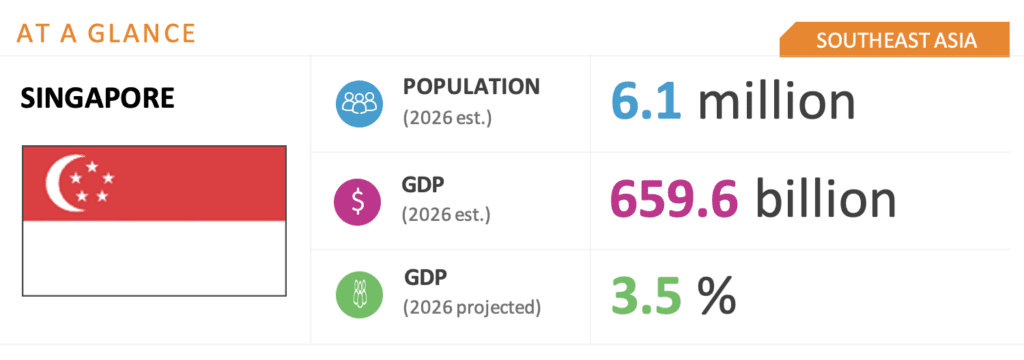
- Singapore’s economy demonstrated resilience in the first quarter of 2026 with a year-on-year growth rate of 4.6 percent. The slight contraction of 0.3 percent from the previous quarter signals that headwinds may begin to materialize. The ongoing Middle East conflict will likely be the greatest threat to growth for the rest of the year.
- This will significantly impact Singapore’s outward-facing economy, with businesses confronting surging energy costs and potential supply chain disruptions. Singapore has accelerated its search to diversify suppliers and energy sources. Several feasibility studies on nuclear technologies and geothermal energy have been announced.
- The Economic Strategy Review, chaired by Deputy Prime Minister Gan Kim Yong, shared its recommendations in mid-May, with the report expected to be published soon. It will incorporate the latest artificial intelligence (AI) initiatives and strategies outlined in the 2026 budget, setting the stage for Singapore’s long-term economic objectives.
ON THE HORIZON
- Singapore’s Ministry of Digital Development and Information is expected to table the long-awaited Digital Infrastructure Act in Parliament this year, although further delays would not be surprising. Originally targeted for 2024, significant power outages to key financial institutions and telecommunications operators in past months have accelerated the government’s push to finalize legislation to strengthen the resilience and reliability of digital infrastructure. However, emerging concerns around AI and cybersecurity risks are prompting regulators to reassess the framework. Insights from the latest round of consultations that began in May will likely contribute to further refinements and yet another delay in tabling this much-needed legislation.
- In response to the conflict, Singapore postponed its Sustainable Aviation Fuel levy, which would have applied to departing flights from October 2026 to January 2027. The delay comes after the government said it may be more willing to calibrate future increases to its carbon tax during budget debates. This suggests that political leaders may be more open to adjusting their positions amid high operating costs for businesses.
- Singapore will likely enhance cooperation in the green sectors across more markets, with its 2027 Association of Southeast Asian Nations (ASEAN) chairmanship likely to focus on substantive deliverables for AI and sustainability.
Singapore Market Overview and Forecast
Political Climate
Policy Continuity Tested by Geopolitical Crises
The Lawrence Wong government’s swift responses to successive external shocks including U.S. tariffs, escalating Indo-Pacific geopolitical tensions and the Middle East conflict validated the core premise of his 2025 election campaign. Its agility was further demonstrated when it brought forward and enhanced several measures from the 2026 budget ahead of schedule, providing earlier relief to households and businesses before the full weight of rising energy costs could be felt. With the next general elections not due until 2030, the government faces limited immediate political pressure, even if household budgets further tighten.
New members of Parliament have prioritized grassroots issues, including community welfare, support for vulnerable groups, education and social mobility. This reflects their growing awareness of grassroots priorities. The Middle East crisis also provided an unexpected but significant platform to demonstrate their responsiveness ahead of any future promotions. Acting Transport Minister Jeffrey Siow was prominently featured in the government’s crisis response alongside senior heavyweights Gan and Coordinating Minister for National Security and Minister for Home Affairs K. Shanmugam. While Siow’s comments were a signal of confidence, his earlier remarks on public transport reliability drew criticism for lacking tact. This indicates a broader challenge for those transitioning from administrative roles into political office, raising the bar for future newcomers to have both grassroots experience and policy expertise. Nevertheless, the current uncertain external environment highlights the ruling People’s Action Party’s (PAP) strengths. Companies should expect a stable but increasingly reactive policy environment, with measures calibrated to cost-of-living pressures domestically and supply chain disruptions externally. The PAP’s biennial central executive committee elections in late October will likely reinforce policy and political stability. They may also offer initial signals about the next generation of leaders.
Macroeconomic Climate
Growth Resilient but Headwinds Intensifying
The Ministry of Trade and Industry upgraded Singapore’s 2026 GDP growth forecast to 2-4 percent (from 1-3 percent) in February, reflecting strong momentum at the start of the year, driven by global AI-related tailwinds in manufacturing and trade-related services. Advance estimates for the first quarter showed a year-on-year economic expansion of 4.6 percent, supported by gains in manufacturing — specifically in the electronics and transport engineering clusters — and a 9 percent increase in construction. This was bolstered by steady growth in information and communications, finance and professional services. However, the U.S.-Israel-Iran conflict is expected to weigh on activity in coming quarters:
Upside Scenario: A deescalation of Iran tensions would restore shipping flows and take pressure off oil prices. This would allow global AI-related capital expenditure, which has supported the growth of electronics and data-center sectors, to accelerate. Enhanced growth will ease inflationary pressure as import costs recede, allowing Monetary Authority of Singapore more room to pause further tightening of its monetary policy.
Moderate Scenario: If partial disruptions in the Strait of Hormuz continue, energy prices may stabilize, albeit at an elevated rate. Singapore’s GDP growth may only be at the lower end of the 2-4 percent forecast but second-order effects of businesses passing higher freight, electricity and other input costs to consumers may be politicized if costs of living continue to increase without any signs of declining.
Downside Scenario: A protracted conflict that includes a full blockade will significantly impact oil and gas prices. Shortages of inputs will slow industrial manufacturing in key sectors. Should core inflation rise above 2.5 percent, additional central bank tightening will dampen domestic investment. This could result in the contraction of consumer-facing sectors as income erosion deepens the weaker external demand. While Singapore’s refining capacity and diversified energy sourcing provide some buffer against physical supply disruptions, it is not fully insulated from pricing. The Economic Strategy Review’s final recommendations will set the medium-term economic agenda. The resulting key pivots will focus on trade diversification, AI-driven small and medium enterprise transformation and deeper supply chain resilience.
Investment Environment
Innovation Agenda and Energy Security Top of Mind
The Research, Innovation and Enterprise (RIE) 2030 plan commits a record SGD 37 billion (US$28.6 billion) over five years to deepen research and development, with an initial focus on semiconductors, aging and decarbonization. These support various components of Singapore’s AI strategy.
Wong will chair a new National AI Council to steer the country’s AI agenda and coordinate the government’s efforts across research, regulation, talent and industry adoption. The prioritization of advanced manufacturing, connectivity and logistics, health care and finance relies on strong industry ecosystems to quickly scale up AI applications. Expanding the Enterprise Innovation Scheme to include AI expenditures with a 400 percent tax deduction, and a Champions of AI program will support local companies in deploying AI. Merging SkillsFuture Singapore and Workforce Singapore into one agency will streamline how companies engage for skills training and job matching across the workforce.
The Middle East conflict has underscored the imperative of energy security. A geothermal feasibility study was announced in May, building on earlier studies on advanced nuclear technologies and carbon capture. The Energy Market Authority signed a cooperation agreement with Korea on small modular reactors, accelerated solar deployment plans and called for proposals for up to three hydrogen-ready gas turbine units by 2032, adding 1.8 gigawatts to generation capacity. Companies can expect more announcements during Singapore International Energy Week and Singapore’s ASEAN chairmanship. The conflict has also paradoxically generated capital inflows as companies reassess the stability of alternative regional hubs. Taken together, RIE2030, the national AI push and Singapore’s updated energy security focus reflect top-level policy commitment that may prove decisive for companies evaluating long-term investment anchors in the region, so long as they factor in higher operating costs.
We will continue to keep you updated on developments in Singapore as they occur. If you have any comments or questions, please contact BGA Managing Director for Global Trade and Economics Nydia Ngiow at nngiow@bowergroupasia.com.
Best regards,
BGA Singapore Team