















Malaysia Forecast: Elections Loom as Coalition Strains Test Economic Resilience
WHAT YOU NEED TO KNOW
- The Malaysian government has been focused on mitigating spillover effects from the ongoing energy crisis by implementing austerity measures to curb energy usage and domestic demand. The recently announced agreement to end the war in Iran and reopen the Strait of Hormuz has also allowed a resumption of seafaring operations for Malaysian oil tankers, providing Malaysia with more assurance as it seeks to stabilize domestic fuel supply in the immediate term.
- Prime Minister Anwar Ibrahim and his Cabinet have also moved to strengthen trade relations with key partners to diversify export markets and enhance supply chain security amid the ongoing Iran conflict.
- The Ministry of Trade, Investment and Industry has indicated that it will continue to engage with Washington on a new trade deal pending the outcomes of U.S. Section 301 investigations into excess capacity and forced labor.
ON THE HORIZON
- Anwar’s administration will focus on preparations for the next general election which is expected to be held in late 2026 or early 2027. Anwar will aim to resolve internal tussles within his Pakatan Harapan coalition and its coalition partners as he targets a second term as prime minister.
- State elections in Negeri Sembilan, Melaka, Johor and Sarawak are also slated to be held at the end of 2026, with the state assemblies for Negeri Sembilan and Johor already dissolved and voters headed to the polls. The government would ideally want to hold the remaining state elections together with the general election to save costs amid the ongoing energy crisis. The outcome of the state elections may also galvanize calls for an early dissolution of Parliament, with members within the administration’s loose coalition piling pressure on Anwar to call for snap elections before the end of the current parliamentary term.
- The government will also table the federal budget for 2027 in October during the final parliamentary session for the year. This budget will potentially reflect an electoral and populist budget, focusing on public welfare and socioeconomic programs to enhance positive perceptions of the government ahead of the general election.
Malaysia Market Overview and Forecast
Political Climate
Anwar Braces for Electoral Cycle Amid Coalition Strains and Rising Economic Pressure
Prime Minister Anwar’s approval ratings are slipping amid persistent cost-of-living pressures and residual economic uncertainty following the recent Middle East crisis. Despite denying the possibility of snap polls before July, Anwar may still be considering general elections as early as October (roughly 18 months before the end of the current term), aligning with state elections and the 2027 budget announcement. Even as immediate energy-security risks have eased with the ceasefire and the resumption of traffic through the Strait of Hormuz, political sensitivity around fuel subsidies remains high, not least because the continued extension of broad-based subsidies has significantly eroded fiscal space and is likely to weigh heavily on the 2027 budget. Anwar’s strategists may therefore prefer to face voters before any further pump-price adjustments.
At the state level, state elections for Negeri Sembilan and Johor have been slated for July and August, with Melaka also expected to call for election by the end of 2026, serving as a key gauge of support for the unity government. Negeri Sembilan’s political impasse may be further complicated if its constitutional crisis involving the appointment of the Yang di-Pertuan Besar, the state’s monarch, persists. This could lead to legitimacy concerns in formalizing a newly-appointed government following the upcoming state election. It could also necessitate declaring a statewide emergency, which would suspend the political process and delay the appointment of a new state government.
Within the Pakatan Harapan coalition, Parti Keadilan Rakyat’s internal rift deepens as factions loyal to Anwar clash with those aligned with former Deputy President Rafizi Ramli. Rafizi has openly criticized the government since resigning from the Cabinet. Coalition partner the Democratic Action Party has also voiced dissatisfaction at the slow pace of institutional reforms, with a party congress scheduled in July to decide whether party leaders should resign from government positions, possibly affecting the coalition’s cohesion in the lead-up to elections.
Barisan Nasional continues to consolidate with initiatives such as the United Malays National Organization’s Malay Grand Unity program, promoting reconciliatory efforts with former members and rebranding to a more progressive and inclusive image. Continued cooperation with Pakatan Harapan remains under discussion, but Barisan Nasional is well-positioned to play a leading role in future arrangements. With Barisan Nasional publicly announcing its intention to contest independently in the Johor and Negeri Sembilan state elections, the coalition is expected to push for a snap general election, should it perform well in the two states, to capitalize on its momentum. Perikatan Nasional remains in disarray despite efforts to rebuild its grassroots under coalition chairman and Malaysian Islamic Party (PAS) Vice President Dr. Ahmad Samsuri, who took over after Muhyiddin Yassin stepped down. Hamzah Zainuddin was reappointed opposition leader in Parliament after leaving Bersatu to helm a new party that remains aligned with the coalition. Yet continued PAS-Bersatu infighting underscores the absence of any clear mandate on who should lead the opposition in the longer term or serve as its prime ministerial candidate heading into the next general election.
Macroeconomic Climate
Domestic Demand and Investment Sustain Economic Resilience
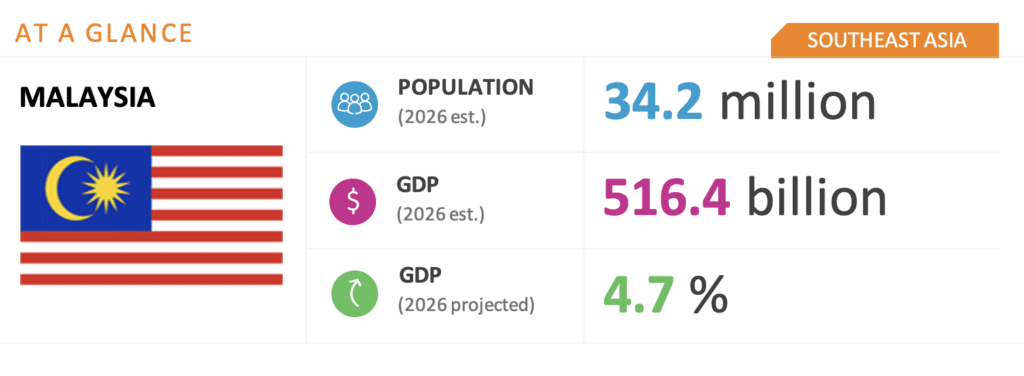
Malaysia remains broadly resilient, supported by firm domestic demand and sustained investment in high-value sectors such as digital infrastructure and electronics. The latest ceasefire between the United States and Iran, together with the gradual resumption of commercial traffic through the Strait of Hormuz, has eased immediate energy-security concerns and reduced the risk of a more severe supply shock, although shipping, insurance and logistics conditions are likely to normalize only progressively. In April, the International Monetary Fund revised Malaysia’s GDP growth projection upward to 4.7 percent. Inflation is still expected to remain manageable, but temporary pass-through effects from earlier fuel and freight disruptions may linger before moderating as energy flows stabilize.
The 2027 budget will be tabled in early October, continuing the trend of reducing the budget deficit to an approximate 3.5 percent of GDP by 2027. However, the continued extension of broad-based fuel subsidies has significantly constrained the government’s fiscal capacity, leaving the budget as the clearest test of its willingness to restore fiscal room through tighter spending discipline, moderated development expenditure and a stronger shift toward targeted assistance. In terms of revenue expansion, the budget will likely focus on adjustments to the sales and services tax framework and stronger compliance measures, rather than introducing politically sensitive reforms. Energy and sustainability initiatives are expected to feature prominently as the government accelerates efforts to diversify the energy mix, with continued support for renewable energy, grid modernization and energy efficiency programs.
The Ministry of Investment, Trade and Industry continues to actively engage with the U.S. Trade Representative on a new tariff deal. Section 301 investigations into forced labor and excess capacity are ongoing with outcomes expected in the second half of 2026. With hostilities in Iran now halted and maritime traffic through the Strait of Hormuz beginning to resume, the central macroeconomic question has shifted from crisis management to the pace of recovery. Three recovery scenarios are now plausible:
Rapid Recovery Scenario: The ceasefire holds and shipping normalizes quickly, bringing down freight and insurance costs within weeks. Malaysia benefits from firmer confidence, stronger external demand and more room to phase subsidy rationalization gradually.
Baseline Recovery Scenario: Shipping resumes but normalization is uneven, with insurers and operators remaining cautious. Energy conditions improve gradually, but higher logistics costs and residual volatility weigh on growth for several months before momentum recovers.
Delayed Recovery Scenario: Although hostilities have ceased, severe damage to energy, port or transport infrastructure slows the restoration of full export capacity and keeps shipping only partially functional. Elevated war-risk premiums, delays and supply bottlenecks prolong imported inflation and keep pressure on growth, fiscal trade-offs and fuel subsidy policy.
Investment Environment
Cautious Optimism as Malaysia Shifts to High-Value Investment
Malaysia’s investment environment is characterized by cautious optimism, underpinned by ongoing policy recalibration and a gradual redirection of global capital flows. Despite moderating global growth, the country continues to position itself as an attractive destination for investors, particularly in high-value and services-driven sectors aligned with the 13th Malaysia Plan.
At the same time, Malaysia remains well-positioned to benefit from diversification trends as investors rebalance exposure away from more volatile regions. With the Strait of Hormuz reopening to commercial traffic, the focus is now less on acute disruption and more on the pace at which confidence, logistics and capital flows normalize. This could still support increased inflows into sectors linked to supply chain resilience, regional logistics and value-added services.
Sustainability is becoming increasingly integral in the investment landscape. The government has deferred the introduction of a carbon tax but will proceed with creating a carbon market and ecosystem through the launch of the National Carbon Market Policy (NCMP), backed legislatively by the National Climate Change Bill.
We will continue to keep you updated on developments in Malaysia as they occur. If you have any comments or questions, please contact BGA Malaysia Managing Director Hafizin Tajudin at htajudin@bowergroupasia.com.
Best regards,
BGA Malaysia Team