















Australia and Japan Deepen Strategic Cooperation Ahead of Leaders’ Meeting
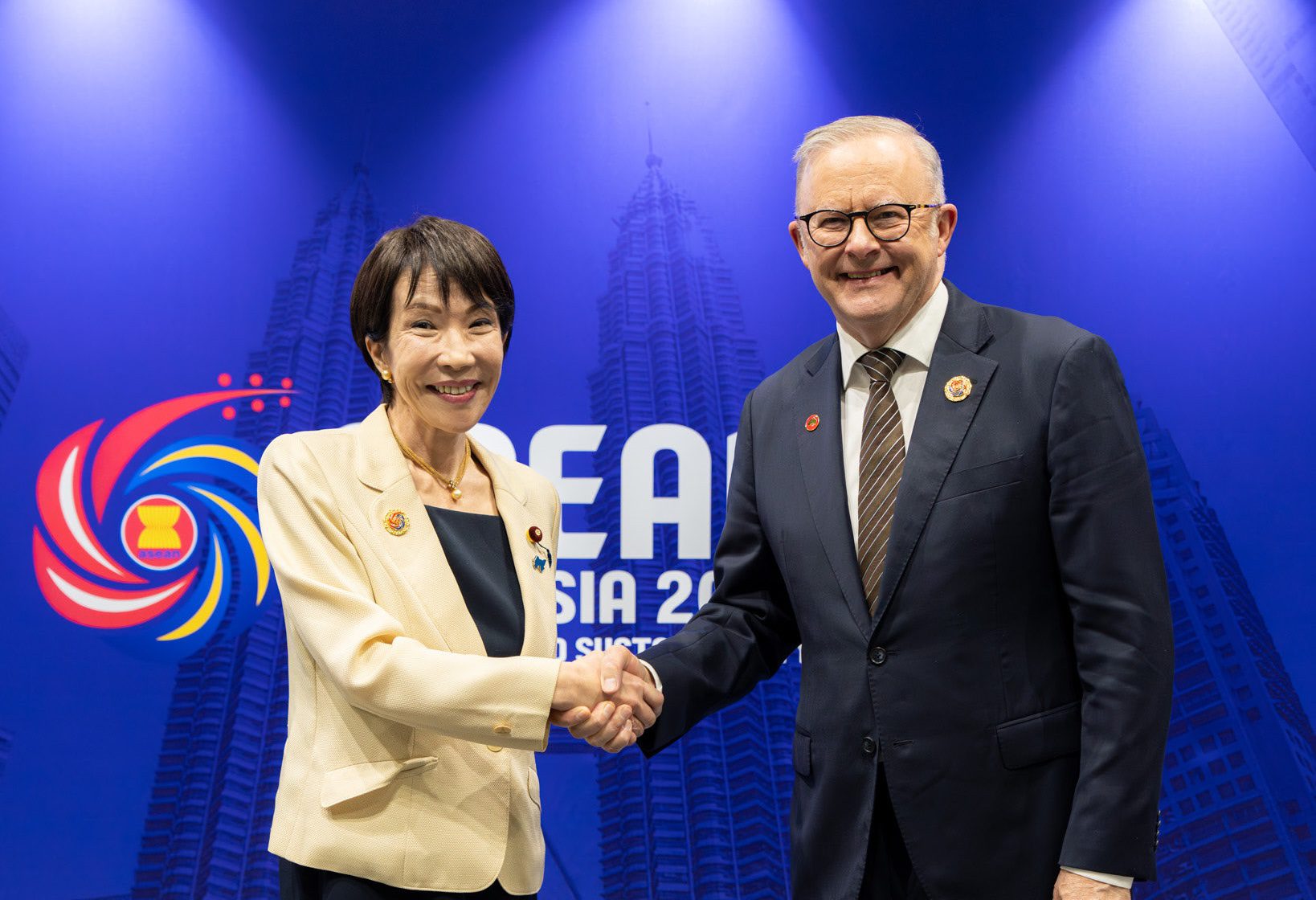
BGA Australia Managing Director Michael “Mick” McNeill and BGA Japan Managing Director Kiyoaki Aburaki wrote an update for clients curtain-raising the meeting between Australian Prime Minister Anthony Albanese and Japanese Prime Minister Sanae Takaichi.
Context
- Australia and Japan have accelerated strategic cooperation across economic and security domains ahead of Prime Minister Sanae Takaichi’s first official visit to Australia since taking office in October 2025. The two countries are exemplifying middle power cooperation amid increased great power competition and the weaponization of economics and trade.
- The Australian and Japanese prime ministers have a strong ambition to elevate the Australia-Japan special strategic partnership across defense, energy and critical minerals. Based on shared democratic values and robust security cooperation, both countries are strengthening defense interoperability, securing energy and critical mineral supply chains and partnering with the United States to advance these efforts.
Significance
- Australian Prime Minister Anthony Albanese will meet with Prime Minister Takaichi at Parliament House in Canberra May 4 for the Australia-Japan annual leaders’ meeting. The visit will be the fourth time the leaders have met, with previous meetings last year on the margins of the East Asia Summit in Kuala Lumpur, Malaysia; the Asia-Pacific Economic Cooperation summit in Gyeongju, Korea; and the Group of 20 summit in Johannesburg, South Africa. This year marks the 50th anniversary since the signing of the Basic Treaty of Friendship and Cooperation between Australia and Japan — the foundation of the partnership.
- Australian Foreign Minister Penny Wong visited Tokyo this week for meetings with her counterpart Motegi Toshimitsu, other Cabinet ministers and industry leaders to discuss energy and fuel security, the Middle East conflict and other issues of shared interest. Wong said Australia and Japan have a relationship built on trust, aligned values and mutual interests. “Together, we support a free and open Indo-Pacific that is inclusive and resilient,” she said. Japan is among the top five countries sourcing refined fuel for Australia, a significant factor in the timing of Wong’s visit. “Imports of fuel from partners like Japan enable Australia to continue to be a reliable exporter of energy and food to the world,” she said.
- Australia’s 2026 National Defense Strategy affirms Japan as “an indispensable partner for achieving regional peace and prosperity.” The strategy commits to increasing information sharing with the Japan Self-Defense Forces, deepening discussions on deterrence activities and enhancing high-end interoperability with the Japan Self-Defense Forces. “Cooperation between the United States, Australia, Japan and the Philippines offers high potential for deeper security engagement across a strategically important geographic area,” the strategy notes.
Implications
- Australian Defense Minister Richard Marles and Japanese Defense Minister Koizumi Shinjiro signed an AUD 10 billion (US$7.2 billion) deal for 11 Japanese-designed Mogami-classfrigates to modernize the Australian navy April 18. The first three ships will be built in Japan, with construction shifting to Western Australia for the remaining eight. The “Mogami memorandum” also agreed to boost industrial collaboration and allow Japanese personnel to participate in flight tests for the Boeing “Ghost Bat” drone conducted in Australia.
- Further loosening of Japanese defense export restrictions could help Australia reduce its dependence on the United States, which is facing strained weapons stocks. In mid-2025, Japan participated for the first time in an Australia-United Kingdom-United States (AUKUS) Pillar II Maritime Big Play activity as part of Exercise Talisman Sabre 2025. The Japan Self-Defense Forces are increasing their presence in northern Australia through regular training rotations and exercises, strengthening trilateral cooperation with Australia and the United States. Shinjiro wants to deepen defense cooperation to deal with an “increasingly severe” security environment.
- Energy, which has long been an area of economic interdependence and strategic cooperation, has been given further momentum from developments in the Middle East. Australia is a stable energy and resources partner, notably in exports of iron ore, coal and liquefied natural gas (LNG), underpinned to a significant extent by Japanese investment. Rising LNG prices have led to calls for an increase in taxes on gas exports in the May 12 budget; however, Albanese said April 29, “Our gas exports are directly linked to our national fuel security. This is why I can confirm that the budget will not undermine existing contracts on gas exports.” Australia supplies almost a third of Japan’s energy needs and more than two-thirds of its strategic raw materials. Both countries are committed to achieving net-zero emissions.
- Japan has sought to reduce its dependence on Chinese critical minerals and rare earths by investing in Australian suppliers, including with the United States. Australia has committed to a Critical Minerals Strategic Reserve and, like Japan, is part of the U.S.-led Pax Silica initiative, which seeks to build secure global technology supply chains. The Australia-Japan Critical Minerals Partnership Strategic Partnership, signed in October 2022, has strengthened collaboration on securing critical minerals supply chains, research, investment and commercial arrangements.
- The deepening strategic ties with Japan, led by a “hawkish” prime minister, has been juxtaposed with the Albanese’s pursuit of “stabilization” of relations with China, Australia’s top trading partner. Wong immediately travelled from Tokyo to Beijing for the Australia-China Foreign and Strategic Dialogue with Chinese Foreign Minister Wang Yi. Nevertheless, the 2026 NDS notes: “China continues to undertake the largest military build-up in the world today, without the transparency or strategic reassurance the region expects.”
We will continue to keep you updated on developments in Taiwan as they occur. If you have any comments or questions, please contact BGA Taiwan Senior Adviser Rupert Hammond-Chambers at rupertjhc@bowergroupasia.com.
Best regards,
BowerGroupAsia

×