
















Australia-US Alliance Energized by Critical Minerals and Rare Earths Agreement
The BGA Australia team, led by Managing Director Michael “Mick” McNeill, wrote an update to clients about the upcoming meeting between Australian Prime Minister Albanese and U.S. President Trump.
Context
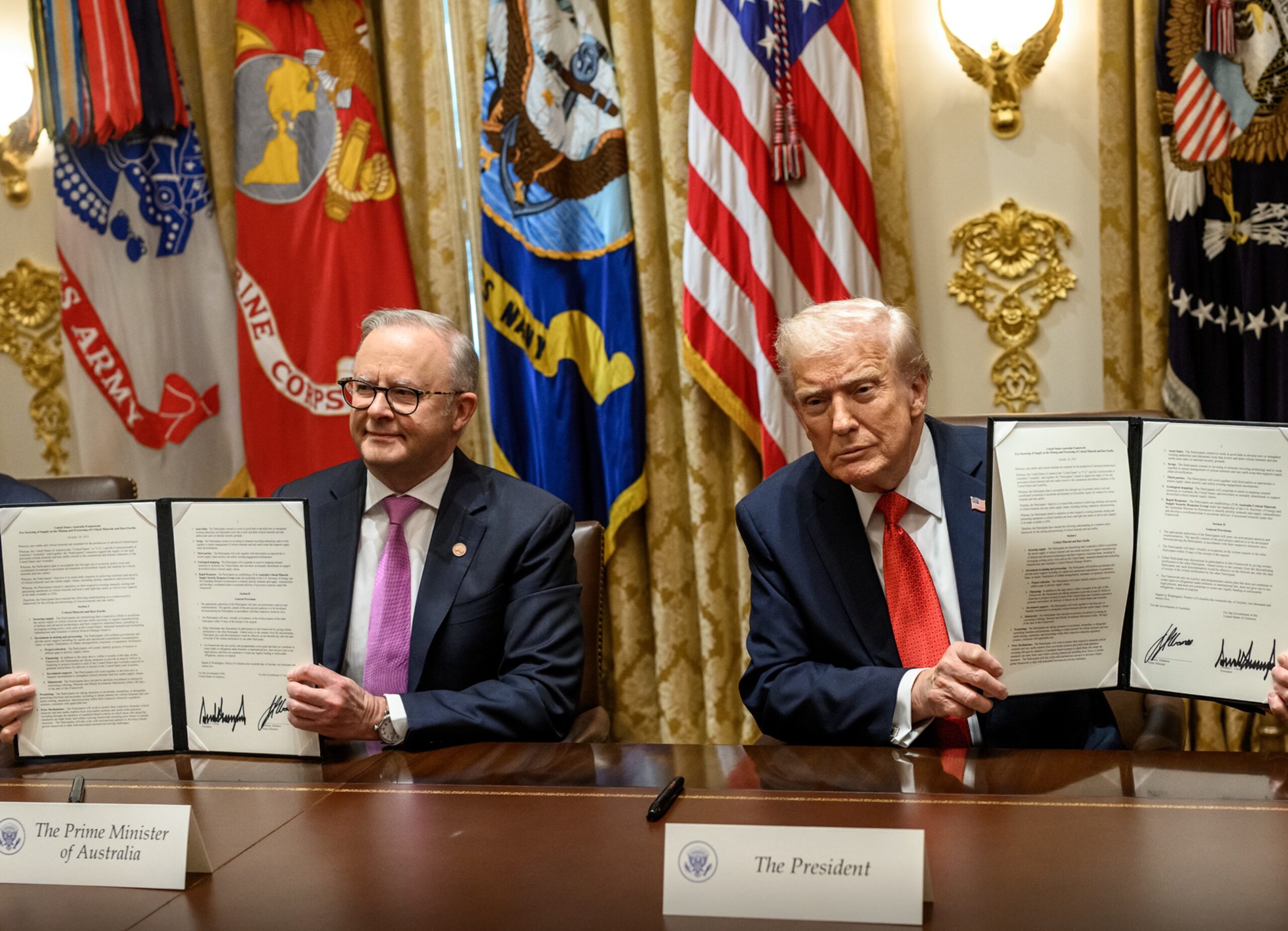
- Australia and the United States have signed a “landmark” agreement on critical minerals and rare earths supply chains that will mobilize government and private sector support. Signed by Australian Prime Minister Anthony Albanese and U.S. President Donald Trump at the White House, the agreement essentially establishes a new pillar of the alliance as both countries seek to reduce their reliance on supply chains dominated by China — Australia’s number one trading partner. Expressing confidence in U.S. military power, Trump downplayed the risk of conflict over Taiwan and anticipated that the United States will “end up with a very strong trade deal” with China.
- The meeting was a triumph for Albanese, who had been criticized by right-wing opponents for not meeting Trump sooner (see BGA’s October 14 update, “Australian Prime Minister To Discuss Security Ties and Critical Minerals With Trump”). Trump declared that the United States was moving “full steam ahead” with the Australia-United Kingdom-United States (AUKUS) trilateral security partnership’s submarine project after a Pentagon review caused uncertainty.
- The United States-Australia Framework for Securing of Supply in the Mining and Processing of Critical Minerals and Rare Earths supports the commercial and defense industries of both countries. This will include leveraging U.S. industrial demand and stockpiling infrastructure as well as Australia’s soon-to-be finalized Critical Mineral Strategic Reserve. Albanese said, “What this is about isn’t just digging things up. It’s also about processing, including joint ventures between Australia and the United States.” President Trump said, “In about a year from now, we’ll have so much critical minerals and rare earths that you won’t know what to do with them.” According to the framework, it “does not constitute or create rights or obligations under domestic or international law.”
Significance
- Australia and the United States will mobilize government and private sector support through guarantees, loans and equity; the finalization of offtake arrangements; insurance; and regulatory facilitation. Both countries will jointly identify projects of interest. Within six months, the Australian and U.S. governments will each provide at least US$1 billion in financing to projects “expected to generate end product for delivery to buyers in the United States and Australia.” This will contribute to an US$8.5 billion pipeline of priority critical minerals projects in Australia and the United States.
- The agreement will be driven by a Mining, Minerals and Metals Investment Ministerial that will meet within six months as well as a U.S.-Australia Critical Minerals Supply Security Response Group. Accompanying Albanese were his ministers for resources and industry and the head of Australia’s Treasury Department. Following the meeting with Trump, Albanese met U.S. Secretary of State Marco Rubio and Treasury Secretary Scott Bessent.
- The framework is the biggest step in Australia-U.S. strategic minerals and rare earths cooperation to date. In 2018, Trump and then-Prime Minister Malcolm Turnbull agreed “to work together on strategic minerals exploration, extraction, processing and research and development of rare earths and high-performance metals.” In May 2023, former U.S. President Joe Biden and Albanese announced “a Climate, Critical Minerals and Clean Energy Transformation Compact, establishing climate, clean energy and a shared energy industrial base as a central pillar of the United States-Australia alliance.”
Implications
- Albanese last month suggested a role for critical minerals and rare earths in Pillar 2 (advanced capabilities) of the AUKUS defense partnership. The government’s Critical Minerals Strategic Reserve, set to commence in 2026, intends to assist Australia and its strategic partners to diversify supply chains beyond China. The Future Made in Australia policy includes a critical minerals production tax incentives for Australia’s 31 critical minerals. In addition, the Australian government will host a Future Made in Australia Investor Forum, to be held in November. The Minerals Council of Australia said the framework showed “AUKUS in action” and confirmed Australia’s integral role in the global supply chain of critical minerals and rare earths.
- The deal will continue to intensify competition for investment and influence in resource-rich Southeast Asian countries, where both the United States and its allies are expected to seek deeper partnerships. Trump’s endorsement of AUKUS reinforces continuity in strategic alignment, signaling a bipartisan U.S. commitment to Indo-Pacific defense cooperation.
- At the same time, regional governments, particularly Indonesia, Malaysia and Vietnam, are adjusting their own industrial strategies, policies and geopolitical positioning. Indonesia is currently tightening downstream policies for critical minerals to ensure local value addition and maintain leverage with both China and Western investors. Malaysia is positioning itself as a midstream processing hub for rare earths while courting diversified partners beyond China. Vietnam is accelerating rare earth exploration but balancing its openness to U.S. and Japanese investment with a cautious approach toward provoking Beijing.
We will continue to keep you updated on developments in Australia as they occur. If you have any questions or comments, please contact BGA Australia Managing Director Michael “Mick” McNeill at mmcneill@bowergroupasia.com or Energy, Climate and Resources Director Chayamon Srisongkram at csrisongkram@bowergroupasia.com.
Best regards,
BGA Australia Team

×