
















Myanmar’s Delayed Fait Accompli: Old Wine in an Old Bottle
Context
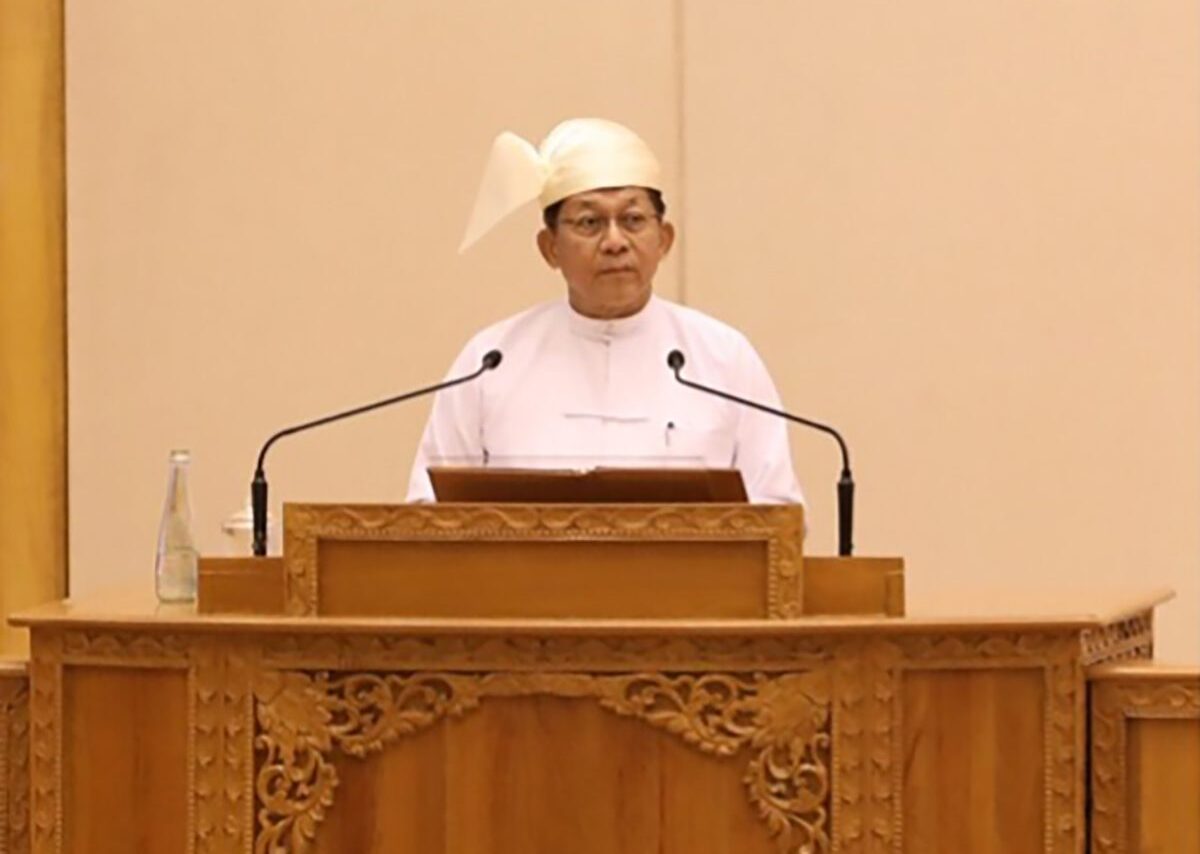
- Five long years after Myanmar’s military seized power on February 1, 2021, what has taken place in the country in recent weeks is a delayed “fait accompli.” Led by Senior Gen. Min Aung Hlaing, then commander-in-chief of the armed forces, the coup deviated from its traditional playbook scripted in 1962 and 1988, when the military rolled out tanks and ruled by force. In fact, the coup this time risked being reversed by a nationwide revolt that evolved into a civil war waged by an armed and determined resistance comprising a civilian-led National Unity Government (NUG), its armed wing — People’s Defense Force (PDFs) — and various ethnic armed organizations (EAOs). But ultimately, the junta known as the State Administration Council (SAC) under Gen. Min Aung Hlaing has achieved what it hopes will be a decisive position by relying on unity and cohesion of the military high command, its deadly brutality and built-in incumbency advantages and a fractious resistance amid favorable geopolitical shifts among the major powers
- The civil war is still being fought fiercely by the resistance coalition against the Tatmadaw (Myanmar’s armed forces), especially in borderland states where central authority is weak and patchy, including Shan, Karen, Rakhine, Kachin and Chin states. However, Min Aung Hlaing has crossed the fait accompli line to assume the presidency after staging a three-step election process last December and January. Although the polls were a foregone farce well before they took place, the legitimacy-lacking outcome has nevertheless allowed Min Aung Hlaing to regain momentum and initiative. He picked longtime loyalist Gen. Ye Win Oo as his successor to run the Tatmadaw prior to the polls and orchestrated post-election parliamentary maneuvers to have himself appointed as president under civilian guises. Min Aung Hlaing will now likely try to consolidate by reclaiming Myanmar’s United Nations seat, which is currently held by an NLD-appointed ambassador. The senior general will also request the country’s shelved chairmanship of the Association of Southeast Asian Nations (ASEAN) in 2029.
Significance
- Bitterly outlasted and outmaneuvered, the resistance coalition has formed a new alliance to build a genuine federal democratic union. Called the Steering Council for the Emergence of a Federal Democratic Union (SCEF), its goals are ending military involvement in politics, electing a civilian government through genuine democratic processes, abrogating the 2008 constitution and replacing it with a new constitution through consensus underpinned by federalism and democratic values. It also pledges to establish a new federal democratic union in accordance with the new constitution and implement a transitional justice system to secure accountability.
In hindsight, the resistance coalition had its chances. Two years into the civil war, the EAOs and PDFs were able to pin down and sap junta forces and morale while gaining more battlefield victories and territories. By October 2023, a so-called “Three Brotherhood Alliance” comprising the Myanmar National Democratic Alliance Army (MNDAA), also known as Kokang; Ta’ang National Liberation Army; and Arakan Army launched a coordinated attack — Operation 1027 — in northern Shan state bordering China, seizing two dozen towns and hundreds of military outposts
- The successful attack emboldened other anti-regime forces to go on the offensive. Not only were borderland states affected, but more villages and towns in the central heartlands were also taken over by resistance columns as myriad military outposts were overrun. Although the SAC resorted to airstrikes and artillery in rearguard actions, the embattled Tatmadaw retreated to make its last stand around major cities, particularly the capital of Naypyitaw. By early 2024, the Arakan Army emerged as the most effective fighting force among the EAOs. While civil war dynamics turned against the SAC, the EAOs became increasingly assertive. The more the EAOs surged, the harder it was for the NUG and PDF units to keep up the pace. Although better trained and armed, the youth-led PDF squads were geared for attrition and grassroots warfare in townships, less adept for the bigger battles the EAOs mounted. By mid-2024, the resistance held more than half of the country’s territory, with internal momentum and external recognition. The NUG, its PDF fighters and allied EAOs could have declared a government at that time. But the NUG fell behind the curve and its leaders proved not up to the task. Lacking voice and visibility, NUG leaders were obscure and tentative, driven by inchoate processes rather than bold results and dominated by older generations from the NLD’s heyday.
Implications
- As the Three Brotherhood Alliance and other EAOs gained the upper hand and the SAC lost the initiative, China felt compelled to secure its interests in Myanmar. As the Three Brotherhood Alliance and other EAOs gained the upper hand and the SAC lost the initiative, China felt compelled to secure its interests in Myanmar. ASEAN, meanwhile, has stuck to its “five-point consensus” (5PC) from April 2021 in the aftermath of the coup. It called for the cessation of violence, humanitarian assistance, release of political prisoners, inclusive dialogue among all parties and an ASEAN envoy to mediate the civil war and conflict. Among the major powers, the United States under the second administration of President Donald Trump has lost considerable leverage. The Trump administration may now be interested in abundant rare-earth deposits in northern Myanmar, but these resources are mostly locked up in Chinese contracts and concessions.
- Moving forward, Myanmar now harks back to the military-dominated period prior to the decade-long civil-military power-sharing from 2011 between Aung San Suu Kyi and Gen. Thein Sein. This time, military dominance is camouflaged by Min Aung Hlaing’s civilian garb and his virtual grip on the Tatmadaw. A broad reopening of Myanmar like before will be difficult because of the mutual animosity between the resistance coalition and the junta, as well as Min Aung Hlaing’s own hardline views. There is too much bad blood for the foreseeable future until Min Aung Hlaing drops out of the picture one way or another. While Myanmar now looks like old wine in an old bottle, businesses can find more space and channels to engage the post-election government, which is desperate to attract foreign investment to shore up a collapsing economy and to show legitimacy. It’s back to business after the polls, if not quite business as usual
BGA will continue to keep clients up to speed on the cut and thrust of what goes on in Myanmar’s political environment and policy repercussions. If you have comments or questions, please contact BGA Senior Adviser Thitinan Pongsudhirak at thitinan@bowergroupasia.com.
Best regards,
BowerGroupAsia