

















Philippines Forecast: ASEAN Leadership and Energy Headwinds Shape a Softer Outlook

WHAT YOU NEED TO KNOW
- The Philippines became chair of the Association of Southeast Asian Nations (ASEAN) for 2026 under the theme “Navigating Our Future, Together.” Anchored on ASEAN’s core principles of peace, stability and inclusive growth, its chair year is guided by three strategic priorities: peace and security anchors, prosperity corridors and people empowerment.
- In response to the challenges arising from the Middle East crisis, President Ferdinand Marcos Jr. issued Executive Order No. 110, declaring a national energy emergency to stabilize supply, ensure the delivery of essential goods and mitigate broader economic consequences, alongside policy and legislative reforms. As ASEAN chair, the Philippines shifted priorities toward energy security, food security and the protection of Southeast Asian nationals.
- In mid-June, the Senate formally elected Sen. Sherwin Gatchalian as Senate president, officially replacing Alan Peter Cayetano following a weeks-long leadership dispute.
ON THE HORIZON
- Marcos will deliver his fifth state of the nation address in July, on the same day as the opening of the second regular session of the 20th Congress. He is expected to outline his administration’s achievements and its priorities for the remainder of his term. These will help shape expectations around policy direction, reform priorities, and the investment climate, which are key considerations for investors.
- As ASEAN chair, the Philippines plans to host around 650 ASEAN-related meetings throughout the year, including two leaders’ summits, which will be attended by the heads of state or government of ASEAN member states and other partners. The 48th ASEAN summit took place in Cebu in May; the 49th summit will be held in Metro Manila in November.
- ASEAN member states concluded negotiations for the ASEAN Digital Economy Framework Agreement (DEFA) in May. The agreement is targeted for signing in November at the 49th ASEAN summit.
- The impeachment trial of Vice President Sara Duterte could extend beyond September as both the prosecution and defense prepare to present numerous witnesses and documentary evidence, according to House prosecutors. The final schedule remains subject to the impeachment court’s discretion. The trial is set to begin July 6.
Philippines Market Overview and Forecast
Political Climate
ASEAN Chair Year Milestones and Priorities
The first half of the year highlighted the Philippines’ ability to adapt to challenges through responsive governance and regional cooperation. These efforts have strengthened resilience and positioned the country to navigate future uncertainties while supporting economic and institutional stability.
As ASEAN chair in 2026, the Philippines is leveraging the ASEAN summits to show its economic resilience and role as a regional hub for cooperation and sustainable development. Priorities such as energy security, food security and the protection of workers indicate ASEAN’s efforts to address geopolitical and economic uncertainties while maintaining regional stability and investor confidence. With the agenda on track, attention is expected to shift toward advancing the Philippines’ remaining priority economic deliverables in the second half of the year.
The 48th ASEAN summit underscored priorities including trade and investment, digital transformation, micro, small and medium enterprise (MSME) development, creative industries and inclusive growth. The adoption of the ASEAN Leaders’ Declaration on AI-Powered MSME Growth and progress toward the DEFA demonstrate the continued momentum on ASEAN’s digital agenda. As negotiations on other initiatives advance, other priority economic deliverables are expected to see progress in the months ahead.
President Marcos Jr. also announced that ASEAN member states adopted the ASEAN Leaders’ Declaration on Maritime Cooperation, which reaffirms ASEAN’s collective commitment to enhancing maritime cooperation and recognizes the multidimensional nature of maritime issues in the region.
Legislative Priorities
The Legislative-Executive Development Advisory Council expanded its Common Legislative Agenda for the 20th Congress to 52 priority measures in February, following the inclusion of four additional bills. Twenty-one of these are targeted for passage by June. These priority measures are expected to advance political reform, strengthen good governance and transparency and support social development. Collectively, they are poised to enhance business confidence and foster a more stable and predictable investment environment, with several measures likely to move forward in the near term.
Macroeconomic Climate
Weaker Growth Outlook Amid External Risks
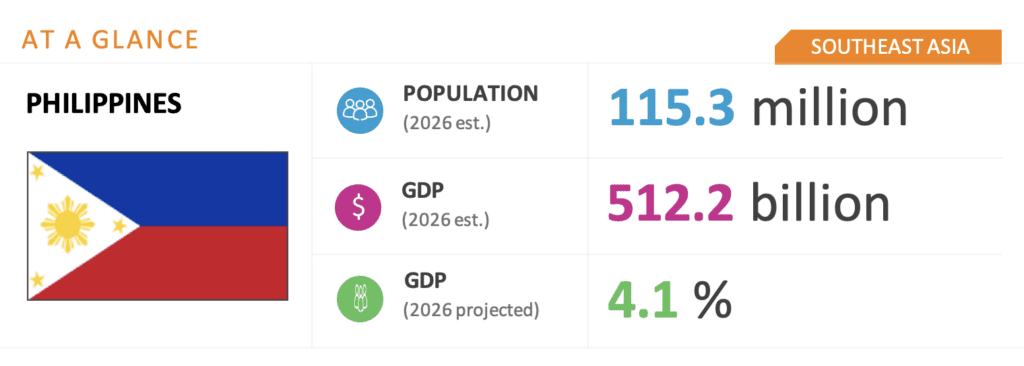
The latest data from the Philippine Statistics Authority (PSA) shows gross domestic product growth slowing to 2.8 percent in the first quarter of 2026. This is the slowest pace since the COVID-19 pandemic, with last year’s corruption scandal and soaring oil prices triggered by the Middle East conflict dampening economic activity. Near-term growth is expected to remain subdued: the first half of 2026 will likely be slow, while the outlook for the second half depends on the effects of external shocks, especially in the Middle East.
Forecasts point to a softer 2026 outlook but gradual recovery thereafter. The World Bank cut its 2026 growth projection for the Philippines to 3.7 percent from 5.3 percent, citing exposure to oil price shocks, before rebounding to 5.6 percent in 2027. The Asian Development Bank similarly expects 4.4 percent growth in 2026 and 5.5 percent in 2027. Price pressures will likely intensify due to higher oil prices, electricity rate adjustments and public transport costs.
Upside Scenario: Fuel prices are expected to decline as hostilities around Iran subside, easing inflation and improving consumer and business sentiment, which supports stronger-than-expected growth.
Moderate Scenario: Growth is expected to remain moderate as consumption stays subdued, especially in transport-sensitive sectors.
Downside Scenario: Fuel prices are expected to rise further from current levels, keeping inflation elevated and weakening demand, investment and overall economic sentiment.
Investment Environment
Recent Investment Performance and Sectoral Trends
The latest data from the Bangko Sentral ng Pilipinas (BSP) shows that net inflows of foreign direct investment (FDI) in the first quarter of 2026 reached $1.7 billion, lower than the $2.1 billion recorded in the same period last year. The BSP expects FDI net inflows to hit $7.5 billion this year, slightly below the $7.8 billion recorded in 2025, due to global uncertainties. Equity capital placements were sourced primarily from Japan, the United States and Singapore and were channeled largely into the manufacturing, financial and insurance and real estate industries.
Despite softer FDI inflows, recent PSA data indicates sustained investment interest in the country, with approved foreign investments reaching PHP 42.6 billion ($698.4 million) in the first quarter of 2026, representing a 52.3 percent year-on-year increase. These foreign investment commitments, which are expected to materialize over the coming years, were driven largely by projects in arts, entertainment and recreation; manufacturing; and accommodation and food service activities. Approved investments with foreign interest are expected to generate more than 13,000 jobs.
Policy Reforms and Investment Outlook
Executive Order No. 113 promulgated the 13th Regular Foreign Investment Negative List, which defines the scope and limits of foreign participation in various industries. Meanwhile, Memorandum Order No. 47, which contains the 2026 Strategic Investment Priority Plan (SIPP), identifies priority sectors, activities and investment areas eligible for incentives under Republic Act No. 12066 or the Corporate Recovery and Tax Incentives for Enterprises to Maximize Opportunities for Reinvigorating the Economy Act. The new SIPP indicates a shift in investment priorities toward high-value industries in response to evolving global economic trends. Together, these measures are expected to improve investment predictability and create new opportunities for business expansion.
The proposed 1,620-hectare industrial hub under the U.S. Pax Silica initiative could strengthen Philippine-U.S. economic ties and position the Philippines to attract higher-value investments in semiconductors and artificial intelligence, supported by its geostrategic location, abundant natural resources and large, young population. Designating the hub as an economic security zone could enhance supply chain resilience, create jobs and support the country’s move toward higher-value activities.
We will continue to keep you updated on developments in the Philippines as they occur. If you have any questions or comments, please contact BGA Philippines Managing Director Victor Andres Manhit at vmanhit@bowergroupasia.com.
Best regards,
BGA Philippines Team