

















Thailand’s Land Bridge: Strategic Ambition Amid Chokepoint Risks
BGA Senior Adviser Dr. Thitinan Pongsudhirak wrote an update on renewed interest in Thailand’s “land bridge” proposal.
Context
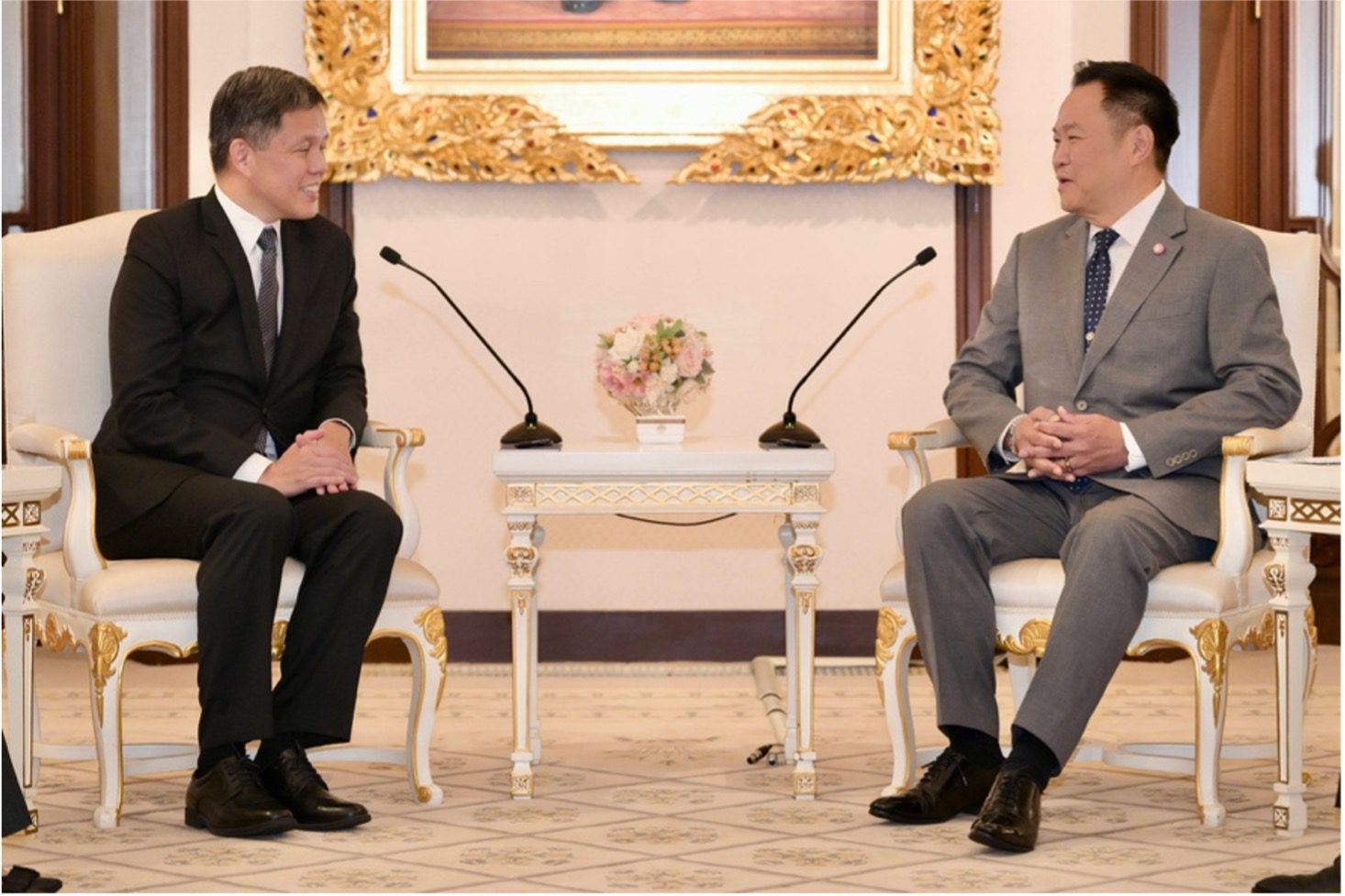
- Thailand’s “land bridge” idea has regained attention, after fluctuating interest over nearly two decades, in response to the ongoing military standoff between the United States and Iran over their mutual blockade of the Strait of Hormuz. Local perceptions used to be that Singapore would oppose any attempt to construct what would be a 90-kilometer road and rail passageway between Ranong and Chumphon provinces on Thailand’s southern peninsula to connect the Andaman Sea with the Gulf of Thailand, thereby linking the Indian and Pacific oceans and bypassing the Strait of Malacca. It is a geostrategic irony that Singaporean Defense Minister Chan Chun Sing expressed interest in the land corridor during his visit to Thailand late last month. However, the likelihood of Thailand’s “land bridge” proposal gaining investment traction and coming to fruition remains limited.
- Singaporean Defense Minister Chan’s support for the Thai land bridge was likely a response to Indonesian Finance Minister Purbaya Yudhi Sadewa’s suggestion just a few days earlier that vessels passing through the Malacca Strait may also face a toll similar to what Iran is demanding with its chokehold over the Strait of Hormuz. Southeast Asia’s cooperation and cohesion under the Association of Southeast Asia Nations’ (ASEAN) institutional framework and mechanisms are both necessary and problematic. Although Singapore is disproportionately strong and dynamic for a country its size, the island nation is tiny compared to its neighbors.
Significance
- For Thailand’s part, the land bridge is a second-best proposal; its origin was the “Kra Canal,” or Thai Canal. Dating back to the 17th century, there has been episodic interest in digging a canal through Thailand’s southern peninsula similar to the famed Suez and Panama precedents. But the idea never took off. By the mid-20th century, the Malay-Muslim ethnonationalist movement in Thailand’s deep south instilled fear and insecurity among Thai elites that physically splitting the land for a canal could lead to secession and lost territories. Assuming adequate funding and all related engineering and logistical requirements alongside the approval among conservative elites, the canal project could have been transformational for Thailand had it been constructed sometime between the 1950s and 1970s or prior. In the internet age, such a gargantuan project would be politicized and divisive among the Thai public. By 2018, Gen. Prayut Chan-ocha, who seized power in 2014 and became prime minister for the next nine years, terminated the canal proposal. It has not been floated since, replaced instead by the land bridge idea.
- As Thailand has now ended up with a low-growth economy below 2 percent per year, the coalition government led by Bhumjaithai Party under Prime Minister Anutin Charnvirakul is desperate for capital-intensive projects. The land bridge idea, in fact, was a signature policy of the previous Pheu Thai Party-led government under former Prime Minister Srettha Thavisin in 2023-2024. It is unusual for Thai coalition governments under different parties to maintain continuity and adopt major policies from one another. Anutin’s land bridge move shows he needs big results to get the economy moving.
Implications
- Apart from the land bridge, the government has also proposed the idea of a broader “southern economic corridor” to attract investment and promote growth. Another approach is to build a trade, investment, industrial and tourism complex centering on Ranong province on the Andaman Sea and link it up with China’s high-speed rail project, which has connected Kunming in Yunnan to Vientiane in Laos, with the extension to Bangkok under construction. This latter approach would still focus on the southern region and deep sea-port development in Rayong but not the overland crossing between the Andaman Sea and the Gulf of Thailand. Alternative plans are being considered because of the massive costs and necessary logistical, legal and political approvals involved.
- Still, businesses should closely monitor the Thai land bridge. Just because it does not make logistical and budgetary sense does not preclude political decision-making and determination to come up with a major infrastructure project to stimulate the Thai economy despite investment risks and fiscal liabilities. The broader lesson from the Thai land bridge idea for investors and businesses is that previous assumptions are being challenged in the current global trade and investment environment. What used to be an open waterway, such as the Strait of Hormuz, can no longer be taken for granted. The Malacca Strait will likely remain free for shipping and navigation, but rising global conflicts will likely put more pressure on maritime chokepoints and risk turning them into chokeholds.
We will continue to keep you updated on developments in Thailand. If you have comments or questions, please contact BGA Senior Adviser Thitinan Pongsudhirak at thitinan@bowergroupasia.com or BGA Thailand Managing Director Teerasak “Art” Siripant at tsiripant@bowergroupasia.com.
Best regards,
BGA Thailand Team

×