

















Côte d’Ivoire Forecast: Stability, Resilient Growth and Green Investment Opportunities

WHAT YOU NEED TO KNOW
- President Alassane Ouattara was reelected for a fourth term in October 2025. Although the election ensures institutional continuity, it has sparked discussions on constitutional matters and political inclusiveness. This dynamic is shaping the political climate, with a focus on maintaining stability while addressing concerns within business circles.
- For the 2025-2026 season, the government set a record farm gate price of XOF 2,800 ($5) per kilogram for cocoa beans. This significantly increases farmers’ nominal income but raises costs for domestic processors and could add upward pressure on export prices if international buyers do not absorb the increase. This historic level reshapes the cocoa sector, temporarily reducing farmers’ vulnerability while straining the competitiveness of local transformation industries.
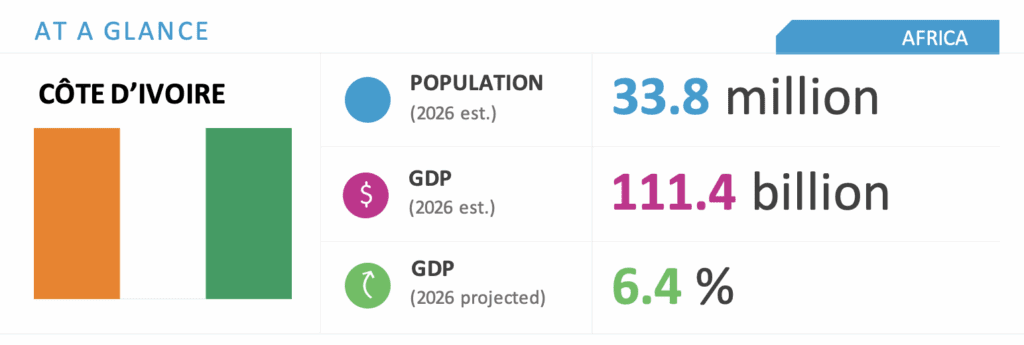
- Official and international institutions maintain a high-growth trajectory for 2026 around 6-6.7 percent, led primarily by continued public and private investment in energy, infrastructure and agriculture.
- The Central Bank of West African States (BCEAO) eased its monetary policy in June 2025 (cutting its key rate by 25 basis points), allowing lower bank lending rates. The Bourse Régionale des Valeurs Mobilières (BRVM) experienced a sharp mid-2025 correction, reflecting persistent volatility in local assets.
- Implementation of new renewable energy tenders and green hospitality investments will expand the energy supply and sustainable tourism capacity in 2026.
ON THE HORIZON
- Companies should monitor the implementation of the government’s policy agenda following the election and its impact on investor confidence during the first months of the new term.
- The timing of bonus payments to growers, reactions from international buyers and possible trade or fiscal negotiations to support the sector (subsidies, credit and storage) warrant attention.
- Clients should watch for progress on the Laboa and Touba solar facilities and the launch of new public-private partnership tenders for industrial zones as well as the absorption of investment into the real economy.
- Companies should monitor sovereign bond issues within the West African Economic and Monetary Union (WAEMU) market (yields), the regional stock market performance and bank credit trends following the Central Bank of West African States’ monetary easing.
Côte d’Ivoire Market Overview and Forecast
Political Climate
Continuity and Inclusive Governance
President Ouattara’s reelection consolidates policy continuity and reinforces perceptions of stability, an essential factor for economic partners and investors. The administration is expected to focus on the swift implementation of its priority economic and social measures, emphasizing inclusive governance and constructive dialogue with domestic stakeholders.
Priority actions include advancing infrastructure and energy projects, supporting agricultural producers through targeted payments and expanding social protection initiatives.
The government will also seek to maintain security and social cohesion through participatory governance and initiatives promoting national unity.
BGA recommends that clients engage proactively with public authorities, maintain open communications on regulatory issues and ensure strong visibility over project-approval processes and timelines.
Macroeconomic Climate
Resilient Growth and Fiscal Discipline
Growth is expected to remain robust at around 6-6.7 percent, with inflation contained at around 3 percent, but fiscal sustainability and debt-service capacity require caution.
Public investment — infrastructure and energy — and domestic consumption remain the main drivers of Côte d’Ivoire’s economic growth. The higher cocoa price increases rural households’ purchasing power, stimulating local demand.
The Central Bank of West African States remains accommodative, with easing trends observed from July-December 2025. Lower policy rates support credit expansion, though delayed effects could emerge through consumer-credit growth or import pressure.
The budget-deficit trajectory continues to narrow. Public debt remains near regional norms but under surveillance. The treasury’s ability to raise funds on WAEMU markets and sustain investor demand for treasury bonds will be decisive.
Shocks to monitor include volatility in global cocoa prices, international energy cost fluctuations and climate-related risks affecting crop yields.
Investment Environment
Green Opportunities and Selective Positioning
Investment opportunities are concentrated in renewable energy, sustainable hospitality, agro-processing and logistics, requiring careful project selection.
The Laboa and Touba solar projects serve as catalysts. Their highly competitive tariffs will reduce industrial energy costs and attract manufacturers sensitive to power pricing. They also mitigate supply risk exposure and create openings for operations and maintenance, energy storage and mini-grid solutions.
The record XOF 2,800 ($5) per kilogram farm gate price for cocoa strengthens farmers’ purchasing power and could spur new investment in local processing, such as grinding chocolate and warehousing. Investors, however, must consider higher raw material costs for operators without long-term purchase contracts and strict compliance with European Union sustainability standards on deforestation and traceability.
Green projects such as Kasada and Cygnum’s Adagio hotel signal growing interest in sustainable hospitality, offering niches for environmental, social and governance-aligned funds and green finance instruments.
Risks to watch include volatility of the regional stock exchange, complex land-tenure frameworks in industrial zones, inland-logistics constraints and the need for strong force majeure and tax-stability clauses in contracts.
We will continue to keep you updated on developments in Côte d’Ivoire as they occur. If you have questions or comments, please contact BGA Senegal Senior Adviser Fabienne Diouf at fdiouf@bowergroupasia.com.
Best regards,
BGA Côte d’Ivoire Team